Augmented Reality E-commerce: 5% Conversion Uplift by 2026

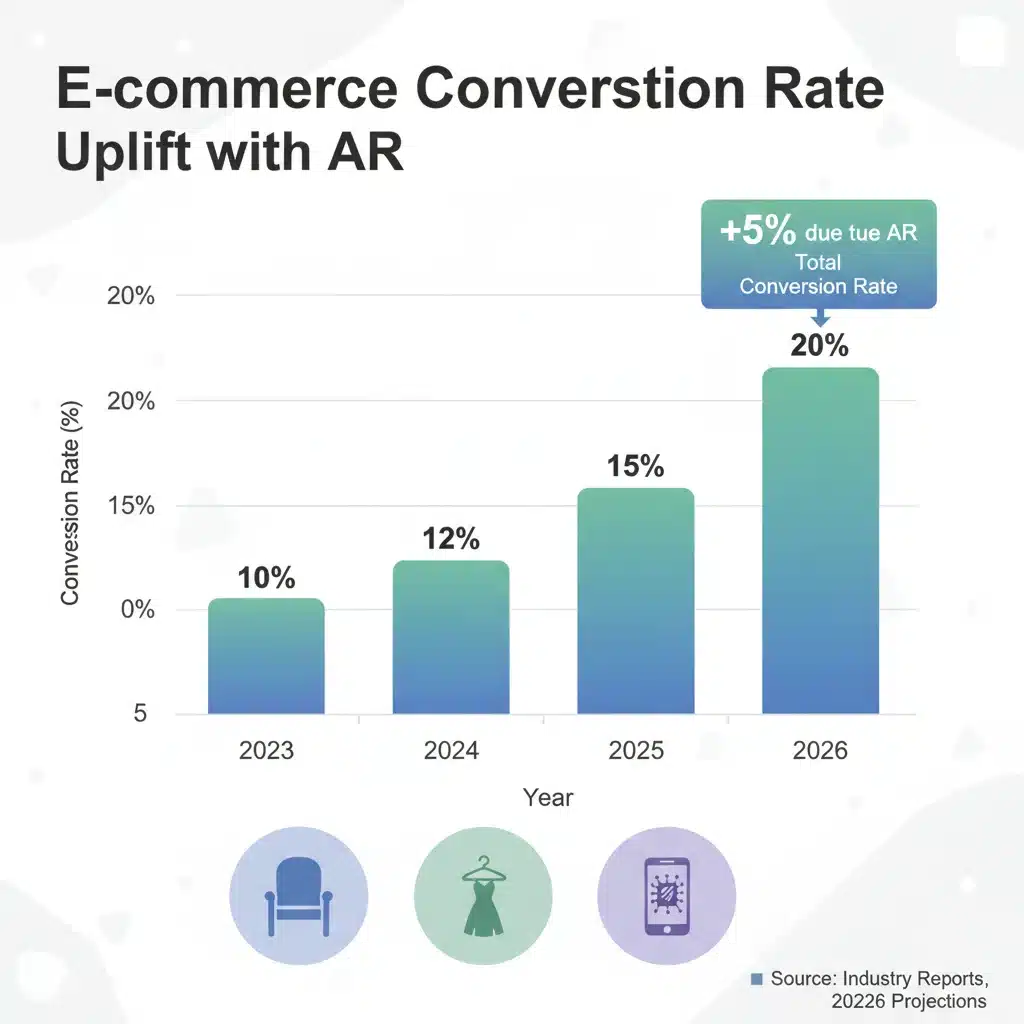
The Impact of Augmented Reality on US E-commerce Sales: A 2026 Forecast for a 5% Conversion Uplift
The digital landscape is in constant flux, with technological advancements continually reshaping how consumers interact with brands and products. Among these innovations, Augmented Reality (AR) stands out as a particularly potent force, poised to revolutionize the e-commerce sector. While once considered a niche technology, AR is rapidly becoming mainstream, offering immersive and interactive experiences that bridge the gap between the physical and digital worlds. This article delves deep into the anticipated impact of AR on US e-commerce, forecasting a significant AR e-commerce conversion uplift of 5% by 2026, and exploring the strategies businesses can employ to harness this transformative power.
Understanding Augmented Reality in E-commerce
Augmented Reality, distinct from Virtual Reality (VR), overlays digital information onto the real world, enhancing a user’s perception of their environment. In the context of e-commerce, this translates to customers being able to virtually try on clothes, place furniture in their homes, or visualize how a product would look and feel before making a purchase. This capability addresses one of the biggest challenges in online shopping: the inability to physically interact with products.
The Evolution of AR Technology
Early iterations of AR were often clunky and required specialized hardware. However, with the proliferation of powerful smartphones and improved AR development kits (like Apple’s ARKit and Google’s ARCore), accessible and high-quality AR experiences are now within reach for millions of consumers. This widespread accessibility is a critical factor in its projected impact on AR e-commerce conversion rates.
Why AR Matters for Online Retailers
For online retailers, AR offers a compelling solution to common pain points. It reduces product returns by providing a clearer understanding of size, fit, and aesthetic. It increases customer engagement by transforming passive browsing into an active, personalized experience. Most importantly, it builds confidence in purchasing decisions, directly contributing to a higher AR e-commerce conversion rate.
Forecasting a 5% Conversion Uplift by 2026
The prediction of a 5% conversion uplift by 2026 is not an arbitrary figure but is grounded in current trends, market analysis, and the observed successes of early AR adopters. This forecast considers several contributing factors:
Increased Consumer Adoption of AR
As AR technology becomes more refined and integrated into everyday devices, consumer familiarity and comfort with these experiences will grow. The younger generations, who are digital natives, are particularly receptive to interactive technologies, driving adoption rates upward. This growing user base provides a fertile ground for AR-powered shopping experiences to thrive and influence AR e-commerce conversion.
Enhanced Product Visualization and Reduced Uncertainty
One of the primary drivers of cart abandonment and product returns in e-commerce is uncertainty. Customers are often hesitant to commit to a purchase when they can’t physically see, touch, or try on an item. AR directly tackles this by allowing customers to visualize products in their own environment. Imagine trying on a pair of glasses or seeing how a new refrigerator fits in your kitchen – this level of visualization significantly mitigates purchase anxiety, leading to higher conversion rates.
Personalized Shopping Experiences
AR enables a degree of personalization previously unattainable in online retail. From virtual try-ons for clothing and makeup to custom configurations of products placed in a user’s home, AR makes the shopping experience uniquely tailored. This personalization fosters a stronger connection between the consumer and the product, encouraging more confident purchasing decisions and boosting AR e-commerce conversion.
Competitive Advantage and Brand Differentiation
In a crowded e-commerce market, differentiation is key. Brands that successfully implement AR not only offer a superior shopping experience but also position themselves as innovative and customer-centric. This can attract new customers and build brand loyalty, indirectly contributing to conversion growth. Early adopters who master AR e-commerce conversion will gain a significant edge.
Improved Data and Analytics
AR platforms can generate valuable data on how customers interact with products in a virtual environment. This data can inform product development, marketing strategies, and user experience improvements, creating a feedback loop that continually refines the shopping journey and optimizes for higher conversion rates.
Key Sectors Benefiting from AR in E-commerce
While AR has broad applications, certain e-commerce sectors are particularly well-suited to leverage its capabilities for significant AR e-commerce conversion gains:
Furniture and Home Decor
This sector was an early adopter of AR, and for good reason. Products like sofas, tables, and rugs are difficult to visualize in a customer’s space. AR apps allow users to virtually place 3D models of furniture in their homes, checking dimensions, style, and fit. Companies like IKEA and Wayfair have already demonstrated the power of AR in this space, leading to reduced returns and increased sales.
Fashion and Apparel
Virtual try-on experiences for clothing, shoes, and accessories are transforming the fashion industry. Customers can see how garments look on their own bodies, experiment with different styles, and get a better sense of fit without ever stepping into a physical store. This not only enhances the shopping experience but also tackles the high return rates often associated with online apparel purchases, directly impacting AR e-commerce conversion.
Beauty and Cosmetics
Trying on makeup virtually has become a popular application of AR. Apps allow users to see how different shades of lipstick, eyeshadow, or foundation would look on their face, eliminating the guesswork and encouraging more confident purchases. Brands like L’Oréal and Sephora have successfully integrated AR into their digital strategies.
Jewelry and Accessories
AR enables customers to virtually try on rings, necklaces, watches, and other accessories, visualizing how they complement their style. This is particularly valuable for high-value items where a confident purchase decision is paramount. The ability to ‘see’ the product on oneself significantly influences AR e-commerce conversion.
Automotive
While not a traditional e-commerce sector, AR is being used by automotive brands to allow potential buyers to explore car models in 3D, customize features, and even place virtual vehicles in their driveways. This immersive experience can be a powerful tool in the pre-purchase research phase, driving leads and ultimately sales.
Challenges and Considerations for AR Implementation
Despite its immense potential, implementing AR in e-commerce is not without its challenges. Businesses must consider several factors to ensure a successful integration and maximize their AR e-commerce conversion uplift:
High-Quality 3D Models
The effectiveness of AR hinges on the quality and realism of the 3D product models. Creating accurate, detailed, and lightweight 3D assets can be resource-intensive and expensive. Poor-quality models can lead to a negative user experience and undermine the benefits of AR.
Technical Integration and Scalability
Integrating AR capabilities into existing e-commerce platforms requires technical expertise. Businesses need to consider compatibility with various devices and operating systems, ensuring a seamless experience for all users. Scalability is also crucial as the product catalog grows.
User Experience (UX) Design
A poorly designed AR experience can be frustrating and counterproductive. Intuitive interfaces, clear instructions, and a smooth user journey are essential for encouraging adoption and ensuring that AR genuinely enhances the shopping process, contributing positively to AR e-commerce conversion.
Performance and Loading Times
AR applications can be resource-intensive, potentially leading to slow loading times or performance issues on older devices or unreliable internet connections. Optimizing performance is critical to avoid frustrating users and causing them to abandon the experience.
Data Privacy and Security
As AR applications interact with a user’s environment and potentially collect data, privacy and security considerations become paramount. Businesses must adhere to data protection regulations and transparently communicate their data handling practices to build user trust.
Cost of Development and Maintenance
Developing and maintaining AR solutions can be a significant investment. Businesses need to carefully evaluate the return on investment (ROI) and ensure that the projected AR e-commerce conversion uplift justifies the expenditure.

Strategies for Maximizing AR E-commerce Conversion
To achieve the forecasted 5% conversion uplift, businesses need to adopt a strategic approach to AR implementation. Here are some key strategies:
Start with High-Impact Products
Instead of trying to implement AR for every product, begin with items that stand to benefit most from visualization, such as furniture, complex electronics, or fashion items prone to high return rates. This allows for focused development and a clear demonstration of ROI for AR e-commerce conversion.
Prioritize Mobile-First AR Experiences
Given that the majority of e-commerce traffic comes from mobile devices, designing AR experiences primarily for smartphones and tablets is crucial. Ensure compatibility across different operating systems and device models to reach the widest possible audience.
Seamless Integration into the Customer Journey
AR should not be a standalone gimmick but an integrated part of the shopping experience. Provide clear calls to action on product pages, making it easy for customers to launch the AR feature. The transition from browsing to AR visualization should be smooth and intuitive to enhance AR e-commerce conversion.
Educate and Guide Users
Not all users will be familiar with AR. Provide clear instructions, tutorials, or onboarding guides to help customers understand how to use the AR feature effectively. A positive first experience is vital for encouraging continued use.
Gather Feedback and Iterate
Continuously collect user feedback on the AR experience. Monitor metrics such as usage rates, engagement times, and, most importantly, the impact on conversion rates and returns. Use this data to iterate and improve the AR solution, further optimizing for AR e-commerce conversion.
Leverage Social Media and Marketing
Promote your AR capabilities through social media, email marketing, and other channels. Showcase compelling examples of how customers can use AR to enhance their shopping. User-generated content featuring AR experiences can be particularly powerful in demonstrating value and driving adoption.
Consider Web-Based AR (WebAR)
WebAR allows users to access AR experiences directly through their web browser without needing to download a separate app. This significantly lowers the barrier to entry and can lead to higher engagement rates, directly influencing AR e-commerce conversion by making the experience more accessible.
The Future of AR in US E-commerce Beyond 2026
While a 5% conversion uplift by 2026 is a significant milestone, the journey of AR in e-commerce is far from over. Looking beyond this forecast, several trends suggest an even deeper integration of AR into the retail landscape:
Spatial Computing and the Metaverse
The evolution of AR is closely tied to the broader concept of spatial computing and the metaverse. As these technologies mature, AR shopping experiences will become even more immersive, allowing users to interact with digital products in highly realistic and persistent virtual environments. This could lead to entirely new forms of retail and further enhance AR e-commerce conversion.
AI-Powered Personalization in AR
Combining AR with Artificial Intelligence will unlock unprecedented levels of personalization. AI could analyze user preferences, body measurements, and environmental data to offer highly tailored product recommendations and AR visualizations, making the shopping experience even more intuitive and effective.
Haptic Feedback and Multi-Sensory Experiences
Future AR applications may incorporate haptic feedback, allowing users to ‘feel’ the texture or weight of a virtual product. This multi-sensory approach would further blur the lines between physical and digital shopping, making online purchases even more confident and impacting AR e-commerce conversion positively.
AR in Physical Stores (Phygital Retail)
AR will not be confined to online shopping. It will increasingly be used in physical retail environments to enhance the in-store experience, offering product information, virtual try-ons, and interactive displays. This ‘phygital’ approach will create a seamless customer journey across all touchpoints.
Democratization of AR Content Creation
As AR development tools become more user-friendly and accessible, even smaller businesses will be able to create compelling AR experiences without requiring massive budgets or specialized teams. This democratization will accelerate AR adoption across the entire e-commerce ecosystem, driving widespread gains in AR e-commerce conversion.
Conclusion
The forecast of a 5% AR e-commerce conversion uplift by 2026 in the US market underscores the profound impact Augmented Reality is set to have on online retail. By offering enhanced product visualization, reducing uncertainty, and delivering personalized, engaging experiences, AR addresses critical pain points for both consumers and businesses. While challenges in implementation exist, the strategic adoption of AR, coupled with ongoing technological advancements, positions it as a cornerstone of future e-commerce success. Retailers who embrace this technology proactively will not only gain a competitive edge but will also redefine the very essence of online shopping, creating a more interactive, confident, and ultimately, more profitable experience for everyone.
The journey towards this 5% uplift is already underway, and businesses that invest in understanding and integrating AR into their digital strategies will be well-positioned to capitalize on this transformative wave, ensuring sustained growth and relevance in an ever-evolving market.