Predictive Analytics in Supply Chain: Optimize Inventory & Cut Overstock

Predictive Analytics in Supply Chain: Optimize Inventory Levels and Reduce Overstock
In today’s rapidly evolving global marketplace, businesses face unprecedented challenges in managing their supply chains. Volatile demand, unpredictable disruptions, and the ever-present pressure to reduce costs make traditional inventory management methods increasingly insufficient. Enter predictive analytics in supply chain – a transformative approach leveraging advanced data science to forecast future trends, optimize inventory, and significantly mitigate the risks of overstocking and understocking. This article delves into how predictive analytics is revolutionizing supply chain operations, offering a clear path to achieving greater efficiency, resilience, and profitability.
The promise of predictive analytics is not merely theoretical; it’s a tangible reality for leading organizations. By harnessing the power of historical data, real-time information, and sophisticated algorithms, companies can move beyond reactive decision-making to proactive strategic planning. Imagine a world where you can anticipate demand shifts before they happen, identify potential supply bottlenecks weeks in advance, and maintain optimal inventory levels with unparalleled precision. This is the power of predictive analytics in supply chain, enabling businesses to not only survive but thrive in complex operational environments.
The Imperative for Predictive Analytics in Modern Supply Chains
The modern supply chain is a labyrinth of interconnected processes, stakeholders, and data points. From raw material sourcing to final product delivery, every stage presents opportunities for optimization and potential pitfalls. Traditional inventory models, often based on simple averages or historical patterns, struggle to cope with the dynamism of today’s markets. Factors such as seasonality, promotions, economic fluctuations, geopolitical events, and even social media trends can dramatically impact demand and supply, rendering static forecasts obsolete almost as soon as they are made.
This is where predictive analytics in supply chain becomes indispensable. It offers a sophisticated framework for understanding and anticipating these complex interactions. Instead of just looking at what happened, predictive analytics focuses on predicting what will happen. This forward-looking capability is crucial for:
- Reducing Overstock: Excess inventory ties up capital, incurs storage costs, risks obsolescence, and can lead to significant write-offs. Predictive models can forecast demand with higher accuracy, allowing companies to order and stock only what is truly needed, thereby minimizing surplus.
- Preventing Understock/Stockouts: Conversely, insufficient inventory leads to lost sales, dissatisfied customers, and damaged brand reputation. Predictive analytics helps maintain optimal stock levels to meet anticipated demand, ensuring product availability when and where it’s needed.
- Improving Operational Efficiency: With better forecasts, businesses can optimize production schedules, transportation routes, and labor allocation, leading to smoother operations and reduced waste across the entire supply chain.
- Enhancing Customer Satisfaction: Reliable product availability and faster fulfillment times directly translate to happier customers and stronger brand loyalty.
- Gaining Competitive Advantage: Companies that effectively leverage predictive analytics can respond more quickly to market changes, outmaneuvering competitors and capturing greater market share.
The transition to a data-driven supply chain is no longer an option but a strategic necessity for businesses aiming for sustainable growth and resilience.
Key Components of Predictive Analytics for Inventory Optimization
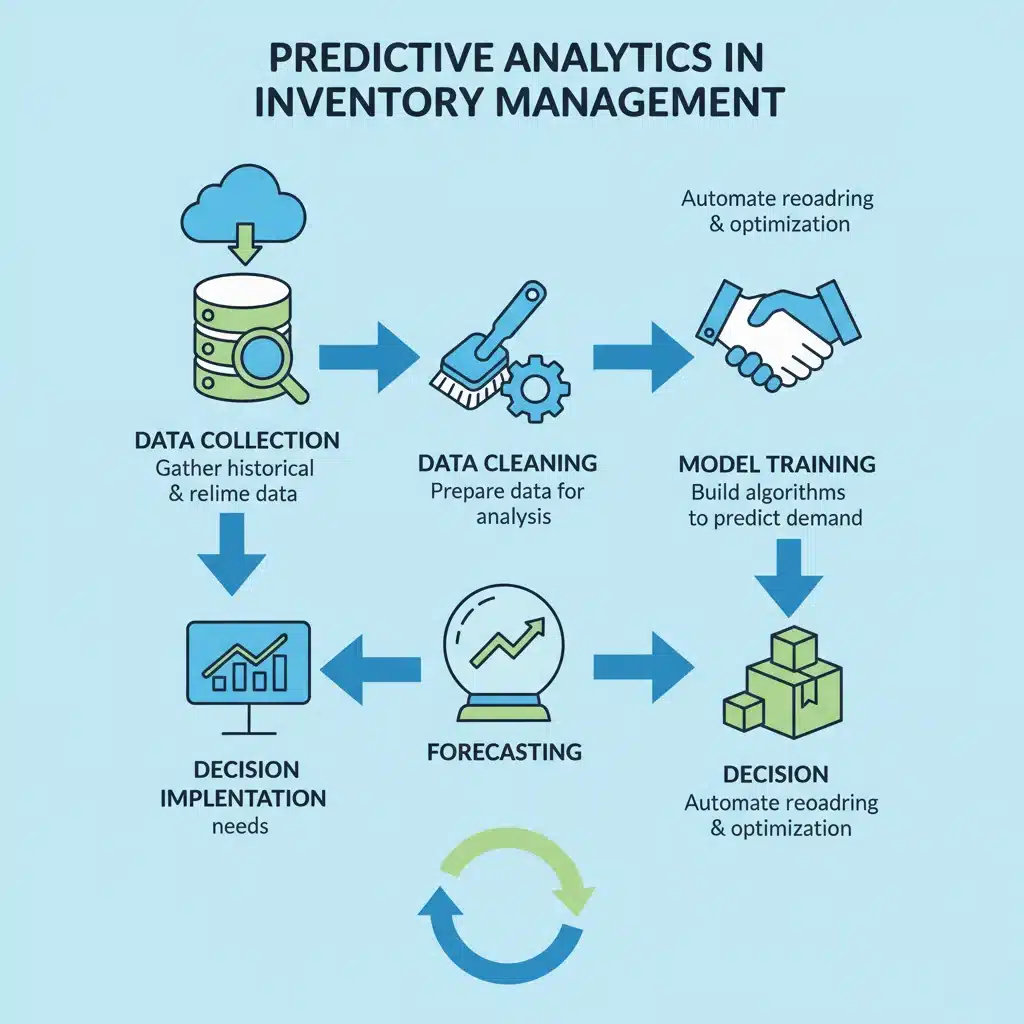
Implementing predictive analytics in supply chain for inventory optimization involves several critical components working in concert. Understanding these elements is fundamental to building a robust and effective solution.
1. Data Collection and Integration
The foundation of any predictive model is high-quality, comprehensive data. This includes:
- Historical Sales Data: Transaction records, sales volumes, and revenue figures over extended periods.
- Inventory Data: Current stock levels, lead times, safety stock, reorder points, and supplier performance.
- External Data: Economic indicators (GDP, inflation, consumer confidence), weather patterns, social media trends, competitor activities, news events, and seasonal calendars.
- Marketing and Promotional Data: Information on past and planned marketing campaigns, discounts, and product launches, as these significantly impact demand.
- Supply Chain Event Data: Records of disruptions, delays, quality issues, and transportation incidents.
Integrating these disparate data sources into a unified platform (e.g., a data warehouse or data lake) is crucial for creating a holistic view necessary for accurate predictions. Data cleanliness, consistency, and accessibility are paramount.
2. Advanced Statistical Modeling and Machine Learning
Once data is collected and prepared, various statistical and machine learning techniques are employed to build predictive models. These can include:
- Time Series Analysis: ARIMA, SARIMA, Exponential Smoothing for identifying patterns and trends over time.
- Regression Models: Linear, multivariate, and logistic regression to understand relationships between variables (e.g., how price changes affect demand).
- Machine Learning Algorithms: Decision Trees, Random Forests, Gradient Boosting Machines, Neural Networks. These are particularly powerful for uncovering complex, non-linear relationships and handling large datasets.
- Clustering: To group similar products, customers, or regions for more targeted forecasting.
The choice of model depends on the nature of the data, the complexity of the problem, and the desired accuracy. Often, a combination of models or ensemble methods yields the best results for predictive analytics in supply chain.
3. Scenario Planning and Simulation
Beyond simply predicting, predictive analytics enables businesses to run ‘what-if’ scenarios. Supply chain managers can simulate the impact of various decisions (e.g., increasing safety stock, launching a new promotion, or a potential supplier delay) on inventory levels, costs, and service levels. This allows for proactive risk assessment and strategic decision-making without real-world consequences.
4. Real-time Monitoring and Alerting
The effectiveness of predictive models is enhanced by continuous monitoring. Real-time data feeds allow models to be updated frequently, adapting to new information and changing market conditions. Automated alerts can notify managers of potential deviations from forecasts, impending stockouts, or excessive inventory buildup, enabling timely intervention.
Strategies for Optimizing Inventory Levels with Predictive Analytics
The application of predictive analytics in supply chain offers several strategic avenues for optimizing inventory. These strategies move beyond traditional approaches, providing a more nuanced and responsive inventory management system.
Dynamic Safety Stock Calculation
Traditional safety stock calculations often rely on static parameters, failing to account for fluctuating demand and lead time variability. Predictive analytics allows for dynamic safety stock adjustments. By forecasting demand volatility and lead time uncertainty more accurately, models can recommend optimal safety stock levels that minimize holding costs while ensuring desired service levels. This means less capital tied up in unnecessary buffer stock during stable periods and adequate protection during volatile times.
Demand Forecasting Accuracy Improvement
At the heart of inventory optimization is accurate demand forecasting. Predictive models, especially those incorporating external factors, can significantly outperform traditional methods. They can identify subtle trends, cyclical patterns, and the impact of promotions or external events with greater precision. This enhanced accuracy directly translates to ordering the right quantities at the right time, drastically reducing both overstock and stockouts.
Optimized Reorder Points and Quantities
With precise demand forecasts and dynamic safety stock levels, businesses can establish more intelligent reorder points and economic order quantities (EOQ). Predictive analytics can suggest when to reorder and how much to order to minimize total inventory costs (holding costs + ordering costs) while maintaining service level targets. This moves away from arbitrary thresholds to data-driven, optimized replenishment strategies.
Supplier Performance Prediction and Management
Predictive analytics can also be applied to supplier performance. By analyzing historical delivery times, quality issues, and responsiveness, models can predict potential supplier delays or reliability issues. This allows supply chain managers to proactively engage with suppliers, seek alternative sourcing, or adjust inventory buffers in anticipation of disruptions, further safeguarding against stockouts and managing lead time variability effectively.
Personalized Inventory Strategies for Product Segments
Not all products are created equal. High-value, fast-moving items require different inventory strategies than slow-moving, low-value ones. Predictive analytics enables businesses to segment their inventory based on demand patterns, profitability, and obsolescence risk. Tailored forecasting and inventory policies can then be applied to each segment, leading to more efficient overall inventory management. For example, highly volatile products might benefit from more frequent, smaller orders, while stable products can be managed with larger, less frequent orders.
Reducing Overstock: A Direct Benefit of Predictive Analytics
The direct financial benefits of reducing overstock are substantial. Excess inventory is not just a storage cost; it’s a drain on capital, a risk of obsolescence, and a potential source of waste. Predictive analytics in supply chain directly addresses this challenge through several mechanisms:
Improved Planning and Procurement
With highly accurate demand forecasts, procurement teams can make more informed purchasing decisions. They can negotiate better terms with suppliers due to more predictable order volumes and avoid rushed, high-cost orders. This precision in planning means fewer instances of ordering too much product that then sits in warehouses.
Reduced Obsolescence Risk
For products with short shelf lives or those susceptible to rapid technological change (e.g., electronics, fashion, fresh produce), overstock can quickly turn into obsolete inventory, leading to significant write-offs. Predictive models can forecast product lifecycles and demand curves more accurately, allowing businesses to clear out older stock before it loses all value and avoid accumulating new stock that will soon become outdated.
Optimized Warehouse Utilization
Less overstock means less space required in warehouses. This can lead to reduced warehousing costs (rent, utilities, labor) or free up valuable space for higher-value activities. Efficient space utilization is a direct consequence of precise inventory management driven by predictive insights.
Better Cash Flow Management
Capital tied up in excess inventory is capital that cannot be invested elsewhere in the business. By reducing overstock, companies free up working capital, improving cash flow and financial liquidity. This enables investments in growth initiatives, research and development, or other strategic areas.

Implementing Predictive Analytics in Your Supply Chain
Embarking on the journey of implementing predictive analytics in supply chain requires a structured approach. It’s not just about technology; it’s about people, processes, and a commitment to data-driven decision-making.
1. Define Clear Objectives and Scope
Start with a clear understanding of what you want to achieve. Are you primarily focused on reducing overstock for a specific product category, improving service levels, or optimizing a particular segment of your supply chain? Defining a clear scope prevents scope creep and ensures measurable results.
2. Assess Data Readiness
Evaluate your current data infrastructure. Do you have access to clean, reliable, and relevant historical and real-time data? Identify data gaps and develop a strategy for data collection, cleaning, and integration. This might involve upgrading existing systems or implementing new data management tools.
3. Build a Cross-Functional Team
Successful implementation requires collaboration between IT, data scientists, supply chain managers, procurement, and sales. Each department brings unique insights and expertise crucial for developing and deploying effective predictive models.
4. Choose the Right Tools and Technologies
Invest in appropriate predictive analytics platforms. This could range from open-source machine learning libraries to commercial AI/ML platforms and specialized supply chain planning software. Consider factors like scalability, ease of integration, and user-friendliness.
5. Start Small, Scale Gradually
Begin with a pilot project in a manageable area of your supply chain. This allows you to test models, refine processes, and demonstrate value without disrupting the entire operation. Learn from initial successes and failures, then gradually expand the application of predictive analytics across other areas.
6. Monitor, Evaluate, and Refine
Predictive models are not static. They need continuous monitoring, evaluation, and refinement. As market conditions change and new data becomes available, models must be updated and re-trained to maintain their accuracy and relevance. Establish key performance indicators (KPIs) to track the impact of your predictive analytics initiatives.
Challenges and Considerations
While the benefits are significant, implementing predictive analytics in supply chain comes with its own set of challenges:
- Data Quality and Availability: Poor data quality can undermine even the most sophisticated models. Ensuring data accuracy, completeness, and consistency is often the biggest hurdle.
- Talent Gap: There’s a high demand for data scientists and analytics professionals with expertise in supply chain. Companies may need to invest in training existing staff or hiring new talent.
- Integration Complexities: Integrating new analytics platforms with existing ERP, WMS, and other legacy systems can be complex and time-consuming.
- Change Management: Shifting from traditional, instinct-based decision-making to data-driven approaches requires a significant cultural change within the organization.
- Model Interpretability: Some advanced machine learning models can be ‘black boxes,’ making it difficult to understand how they arrive at their predictions. This can hinder trust and adoption by business users.
Addressing these challenges requires a strategic, long-term commitment and a willingness to adapt and learn.
The Future of Supply Chain: An Analytics-Driven Ecosystem
The trajectory of supply chain management is undeniably moving towards an analytics-driven ecosystem. As data proliferates from IoT devices, sensors, and interconnected systems, the capabilities of predictive analytics in supply chain will only grow. We can anticipate even more sophisticated models that incorporate real-time environmental factors, geo-political risk assessments, and highly personalized customer demand signals.
Imagine autonomous supply chains where AI-powered systems not only predict but also automatically execute decisions for inventory replenishment, dynamic pricing, and even proactive rerouting of shipments to avoid disruptions. While fully autonomous supply chains are still some way off, the foundational blocks are being laid today through the adoption of predictive analytics.
Businesses that embrace this transformation will be better positioned to navigate future uncertainties, optimize their operations, and deliver superior value to their customers. Those who cling to outdated methods risk being left behind in an increasingly competitive and data-driven world.
Conclusion
Predictive analytics in supply chain is no longer a luxury but a strategic imperative for businesses seeking to optimize inventory levels, drastically reduce overstock, and enhance overall operational resilience. By leveraging the power of data, advanced statistical models, and machine learning, companies can transform their supply chain from a cost center into a source of competitive advantage.
The journey involves careful planning, robust data management, the right technological investments, and a commitment to continuous improvement. While challenges exist, the profound benefits – from significant cost savings and improved cash flow to enhanced customer satisfaction and a stronger market position – make the investment in predictive analytics an undeniable driver of future success. Embrace the power of prediction, and unlock a leaner, more efficient, and more profitable supply chain.