Predictive Analytics Retail: Forecasting Trends 6 Months Ahead for Merchandising
In the fiercely competitive landscape of modern retail, staying one step ahead is not just an advantage; it’s a necessity. The ability to anticipate consumer demand, identify emerging trends, and optimize product assortments before they become prevalent can be the differentiator between thriving and merely surviving. This is where predictive analytics retail emerges as a game-changer, offering retailers the power to peer into the future and make data-driven decisions that significantly impact their bottom line. Imagine a world where you could reliably forecast consumer trends six months in advance, allowing for merchandising strategies that are 20% more effective, leading to reduced waste, increased sales, and happier customers. This isn’t science fiction; it’s the tangible reality that predictive analytics retail brings to the table.
The traditional methods of forecasting, often reliant on historical sales data and anecdotal evidence, are no longer sufficient to navigate the complexities of today’s dynamic market. Consumers are more informed, their preferences are evolving at an unprecedented pace, and external factors, from global events to social media trends, can dramatically shift buying patterns overnight. Retailers who continue to operate with rearview mirror insights risk being perpetually reactive, missing out on crucial opportunities, and accumulating costly excess inventory. The core challenge for retailers today is not a lack of data, but rather the inability to extract meaningful, actionable insights from the vast ocean of information available to them. This article will delve deep into how predictive analytics retail can transform your business, providing a strategic roadmap for leveraging advanced data science to achieve unparalleled merchandising excellence.
The Evolution of Retail Forecasting: From Intuition to Algorithms
For decades, retail forecasting was largely an art form, heavily dependent on the intuition and experience of seasoned merchandisers. Buyers would attend trade shows, observe competitors, and rely on their gut feelings to determine what products would resonate with consumers in the coming seasons. While invaluable in its time, this approach was inherently subjective and prone to error. The advent of basic statistical models brought a degree of objectivity, allowing for trend extrapolation based on historical sales. However, these models often struggled with volatility, seasonality, and the emergence of entirely new product categories or consumer behaviors.
The digital revolution, particularly the rise of e-commerce and omnichannel retail, ushered in an era of unprecedented data generation. Every click, every purchase, every social media interaction produced a data point. Initially, retailers grappled with how to store and process this information. Business intelligence (BI) tools emerged, offering descriptive analytics – the ability to understand what happened in the past. While useful for reporting and performance measurement, descriptive analytics still kept retailers in a reactive mode, looking backward rather than forward.
This is where predictive analytics retail truly shines. Moving beyond ‘what happened’ and ‘why it happened,’ predictive analytics focuses on ‘what will happen.’ It employs sophisticated statistical algorithms, machine learning (ML) models, and artificial intelligence (AI) to analyze historical data, identify patterns, and project future outcomes with a high degree of accuracy. This paradigm shift allows retailers to transition from an intuitive, reactive stance to a proactive, data-driven strategy, fundamentally changing how decisions are made across the entire retail value chain, particularly in merchandising.
Understanding Predictive Analytics in Retail: More Than Just a Crystal Ball
At its core, predictive analytics retail involves using data, statistical algorithms, and machine learning techniques to identify the likelihood of future outcomes based on historical data. In the retail context, this means forecasting customer behavior, sales trends, inventory needs, pricing sensitivities, and even the potential success of new product launches. It’s not about guessing; it’s about making informed predictions based on robust mathematical models trained on vast datasets.
Key Components of Predictive Analytics Retail:
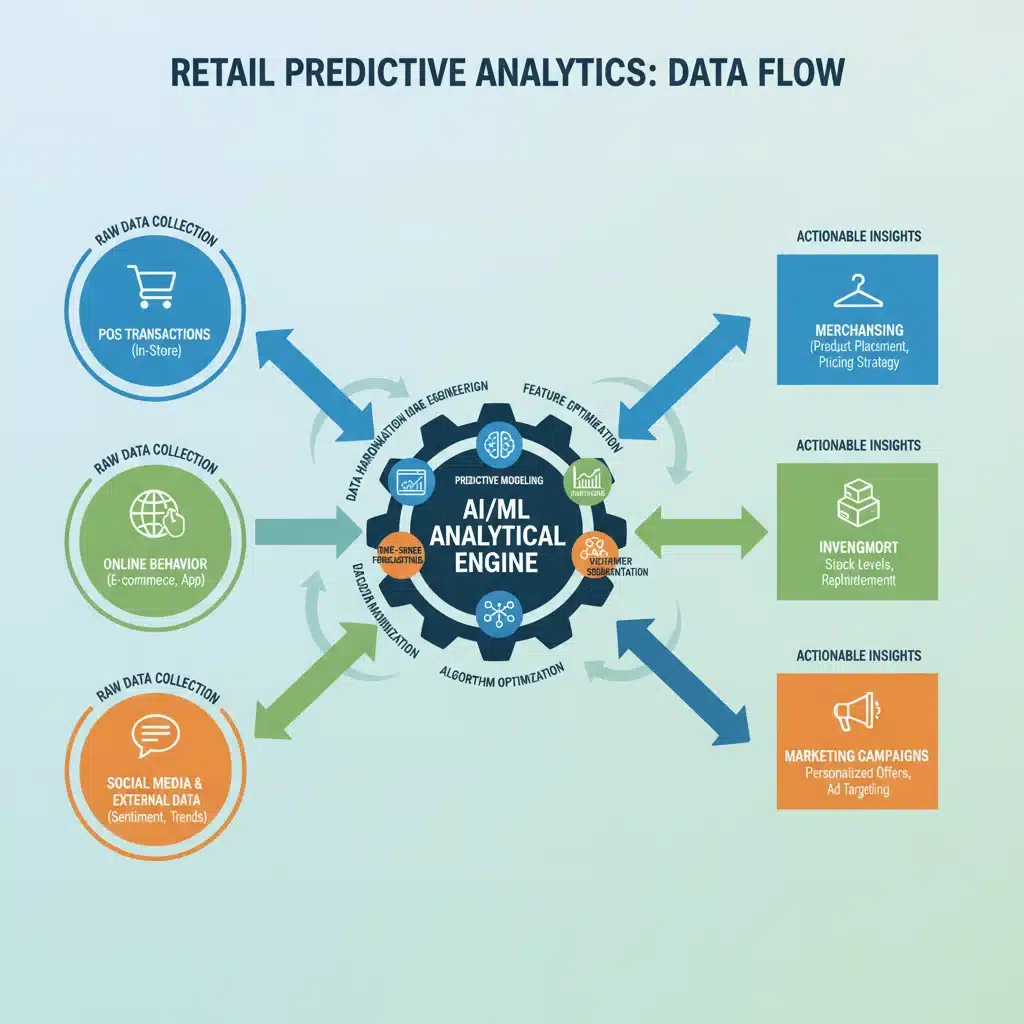
- Data Collection and Integration: The foundation of any effective predictive model is high-quality, comprehensive data. This includes point-of-sale (POS) data, e-commerce transaction logs, customer loyalty program data, website browsing behavior, social media engagement, supply chain data, demographic information, and even external factors like weather patterns or economic indicators. Integrating these disparate data sources into a unified platform is crucial.
- Data Preprocessing and Feature Engineering: Raw data is often messy and needs to be cleaned, transformed, and enriched. Feature engineering involves creating new variables from existing ones to improve the performance of predictive models. For example, deriving a ‘recency, frequency, monetary’ (RFM) score from transaction data.
- Algorithm Selection and Model Building: This is where the advanced analytics come into play. Retailers utilize a variety of machine learning algorithms, including regression analysis, time series forecasting (ARIMA, Prophet), classification algorithms (decision trees, random forests), clustering (k-means), and even deep learning for more complex pattern recognition. The choice of algorithm depends on the specific business problem being addressed.
- Model Training and Validation: Predictive models are trained on historical data, learning the relationships and patterns within it. They are then rigorously validated using separate datasets to ensure their accuracy and generalization capabilities, preventing overfitting.
- Deployment and Monitoring: Once a model is validated, it’s deployed into operational systems, providing real-time or near real-time predictions. Continuous monitoring is essential to ensure the model remains accurate and relevant as market conditions and consumer behaviors evolve.
The power of predictive analytics retail lies in its ability to uncover hidden correlations and intricate patterns that are invisible to the human eye. It can identify subtle shifts in consumer preferences, anticipate seasonal spikes and dips with greater precision, and even predict the impact of marketing campaigns or competitor actions. This foresight translates directly into more strategic merchandising decisions.
Forecasting Consumer Trends 6 Months Ahead: A Strategic Imperative
The ability to forecast consumer trends with a six-month lead time is a significant strategic advantage for any retailer. This extended horizon allows for proactive planning across multiple departments, particularly merchandising, inventory management, and marketing. A six-month window provides ample time to:
- Optimize Product Development and Sourcing: Retailers can collaborate with designers and suppliers to create products that align with future demand, negotiate better terms, and ensure timely delivery.
- Refine Assortment Planning: Merchandisers can curate product selections that perfectly match anticipated consumer tastes, ensuring the right products are available at the right time.
- Strategic Inventory Management: Accurate forecasts enable retailers to order optimal quantities, minimizing both stockouts (lost sales) and overstock (markdowns and carrying costs).
- Develop Targeted Marketing Campaigns: Marketing teams can craft campaigns that resonate with future consumer interests, maximizing engagement and conversion rates.
- Allocate Store Space Effectively: For brick-and-mortar stores, knowing future trends allows for strategic planogram adjustments and visual merchandising that highlights anticipated popular items.
Achieving this level of foresight requires more than just looking at past sales. It demands integrating a wide array of data points and applying advanced analytical techniques. For instance, analyzing social media sentiment, fashion blog trends, search engine queries, macroeconomic indicators, and even competitor product launches can provide early signals of emerging trends. Machine learning models can then process these diverse data streams to identify nascent patterns and project their trajectory over the next half-year.
Achieving 20% Better Merchandising with Predictive Analytics Retail
The promise of a 20% improvement in merchandising effectiveness is not an arbitrary number; it’s a realistic goal for retailers who fully embrace predictive analytics retail. This improvement can manifest in several key areas:
1. Enhanced Assortment Planning and Category Management:
Predictive models can identify which product attributes (color, style, material, brand) will be most popular in the upcoming seasons. This goes beyond just predicting demand for existing items; it helps identify gaps in the current assortment and opportunities for new product introductions. By understanding future demand at a granular level, retailers can optimize their product mix, ensuring they stock items that consumers actually want, rather than relying on historical performance alone. This reduces the risk of dead stock and maximizes the potential for full-price sales.
2. Dynamic Pricing Strategies:
Predictive analytics can forecast demand elasticity and competitor pricing, allowing retailers to implement dynamic pricing strategies. This means adjusting prices in real-time or near real-time to maximize revenue and profit margins. For instance, predicting a surge in demand for certain items can allow for strategic price increases, while anticipating a slowdown can trigger timely promotions to clear inventory without deep discounting.
3. Optimized Inventory Levels and Reduced Stockouts:
One of the most immediate and significant benefits of predictive analytics retail is its impact on inventory management. Accurate demand forecasts reduce the need for buffer stock, lowering carrying costs, warehousing expenses, and the risk of obsolescence. Simultaneously, by predicting potential stockouts for popular items, retailers can proactively reorder, ensuring products are always available, thereby preventing lost sales and customer dissatisfaction. This balance between having enough and not too much is a critical driver of profitability.
4. Personalized Customer Experiences:
Beyond broad trend forecasting, predictive analytics can segment customers based on their predicted future behavior, preferences, and lifetime value. This enables highly personalized marketing campaigns, product recommendations, and promotional offers. Predicting which customers are likely to churn, or which are most susceptible to cross-selling opportunities, allows for targeted interventions that boost customer loyalty and increase average transaction value.
5. Improved Promotional Effectiveness:
Predictive models can assess the likely impact of different promotional strategies before they are launched. By simulating various scenarios, retailers can identify the most effective promotions for specific products or customer segments, optimizing discounts, timing, and channels to maximize ROI and avoid unnecessary margin erosion.
Implementing Predictive Analytics in Your Retail Business: A Step-by-Step Guide
Embarking on the journey of implementing predictive analytics retail might seem daunting, but by breaking it down into manageable steps, retailers can systematically build their capabilities and start reaping the benefits.
Step 1: Define Clear Business Objectives
Before diving into data and algorithms, clearly articulate what business problems you aim to solve. Are you looking to reduce stockouts, improve promotional ROI, identify new trends, or personalize customer experiences? Specific, measurable objectives will guide your entire predictive analytics strategy.
Step 2: Assess Your Data Landscape
Conduct a thorough audit of your current data sources. Identify all available internal data (POS, CRM, ERP, e-commerce, loyalty programs) and potential external data sources (social media, economic indicators, competitor data, fashion trend reports). Evaluate the quality, completeness, and accessibility of this data. Data integration and cleansing will likely be significant initial tasks.
Step 3: Invest in the Right Technology and Talent
Implementing predictive analytics retail requires robust technological infrastructure, including data warehousing or data lakes, powerful processing capabilities, and specialized analytical platforms. More importantly, it requires skilled talent: data scientists, machine learning engineers, and business analysts who can translate complex models into actionable insights. Consider hiring or upskilling your existing team, or partnering with specialized analytics providers.
Step 4: Start Small and Scale Up
Don’t try to solve all problems at once. Begin with a pilot project focused on a specific, high-impact area, such as forecasting demand for a single product category or optimizing inventory for a particular set of SKUs. This allows you to learn, refine your processes, and demonstrate value before scaling to more complex use cases.
Step 5: Build and Validate Models Iteratively
Predictive model development is an iterative process. Start with simpler models and gradually introduce more complexity as you gain experience and data quality improves. Continuously validate your models against real-world outcomes and retrain them regularly to ensure they remain accurate and relevant. The retail environment is constantly changing, so your models must adapt.
Step 6: Integrate Insights into Decision-Making
The most sophisticated predictive models are useless if their insights aren’t integrated into daily operational workflows. Ensure that merchandisers, inventory planners, and marketing teams have easy access to the predictions and understand how to use them. This may involve developing user-friendly dashboards, automated alerts, and clear recommendation engines.
Step 7: Foster a Data-Driven Culture
Ultimately, successful adoption of predictive analytics retail hinges on fostering a culture that values data-driven decision-making. Encourage experimentation, continuous learning, and cross-functional collaboration. Leadership buy-in and communication are vital to drive this cultural shift.
Challenges and Considerations for Predictive Analytics Retail
While the benefits are substantial, implementing predictive analytics retail comes with its own set of challenges that need to be addressed proactively:
- Data Quality and Availability: Poor data quality (inaccurate, incomplete, inconsistent) is the biggest hurdle. Retailers must invest in data governance and data cleanliness initiatives. Fragmented data across various legacy systems can also hinder integration.
- Talent Gap: The demand for data scientists and machine learning experts far outstrips supply. Attracting and retaining top talent can be difficult and expensive.
- Model Complexity and Interpretability: Some advanced machine learning models, particularly deep learning, can be opaque (‘black boxes’), making it difficult to understand why a particular prediction was made. For business users, interpretability is crucial for trust and adoption.
- Ethical Considerations and Bias: Predictive models can inadvertently perpetuate or amplify existing biases in historical data, leading to unfair or discriminatory outcomes (e.g., in personalized recommendations). Retailers must be vigilant about auditing models for bias and ensuring ethical AI practices.
- Integration with Existing Systems: Seamlessly integrating predictive analytics solutions with existing ERP, CRM, and inventory management systems can be complex and require significant IT investment.
- Continuous Monitoring and Maintenance: Predictive models are not ‘set it and forget it.’ They require continuous monitoring, retraining, and updates to maintain accuracy and relevance in a changing market.
Addressing these challenges requires a strategic approach, a willingness to invest, and a commitment to continuous improvement. Retailers who navigate these obstacles successfully will be well-positioned to dominate their markets.
The Future of Merchandising: Hyper-Personalization and Proactive Strategy
The future of merchandising, powered by predictive analytics retail, is one of hyper-personalization and proactive strategy. Imagine a retail environment where:
- Micro-Trend Identification: AI can identify nascent trends in niche communities or specific demographics long before they go mainstream, allowing retailers to capitalize on them early.
- Individualized Assortments: Instead of broad category planning, predictive models could enable highly individualized product assortments, even at the store or customer segment level, optimizing for local preferences and individual purchase histories.
- Predictive Visual Merchandising: AI-powered tools could suggest optimal store layouts and visual displays based on predicted foot traffic patterns, product popularity, and conversion rates.
- Automated Reordering and Allocation: Inventory systems could largely automate reordering and allocation decisions based on real-time and predictive demand signals, freeing up human planners for more strategic tasks.
- Anticipatory Customer Service: Predicting customer issues or potential dissatisfaction before they occur allows for proactive interventions, enhancing loyalty and improving brand perception.
This vision is not distant; elements of it are already being implemented by leading retailers. The continuous advancement of machine learning, coupled with increasing data availability and computational power, will only accelerate this transformation. Retailers who fail to adopt predictive analytics retail risk being left behind, unable to compete with the agility and foresight of their data-driven counterparts.
Conclusion: Embrace Predictive Analytics to Redefine Retail Success
In conclusion, predictive analytics retail is no longer a luxury but a strategic imperative for any retail business aiming to achieve sustainable growth and competitive advantage. The ability to forecast consumer trends six months ahead, optimize merchandising strategies, and achieve a 20% or even greater improvement in efficiency and profitability is a transformative capability. By harnessing the power of data, advanced algorithms, and a forward-looking mindset, retailers can move beyond reactive operations to proactive, data-driven decision-making.
The journey to becoming a truly data-driven retailer is continuous, requiring investment in technology, talent, and a cultural shift. However, the rewards – reduced costs, increased sales, enhanced customer satisfaction, and a stronger market position – are well worth the effort. By embracing predictive analytics retail, businesses can not only navigate the complexities of the modern market but also shape its future, setting new benchmarks for merchandising excellence and operational efficiency. The time to act is now, to turn foresight into tangible success and redefine what’s possible in the world of retail.