DTC CAC Reduction: Insider Strategies for 2026 Competitive Market

The direct-to-consumer (DTC) landscape is more competitive than ever, and 2026 promises to intensify this pressure. For DTC brands, the ability to efficiently acquire customers directly impacts profitability and long-term sustainability. A critical metric in this equation is the Customer Acquisition Cost (CAC). As marketing channels become more saturated and consumer attention harder to capture, achieving a significant DTC CAC reduction is not just an aspiration but a strategic imperative. This comprehensive guide will delve into insider strategies designed to help DTC brands achieve an ambitious 10% reduction in CAC, navigating the complexities of the 2026 market with precision and innovation.
In an environment where every marketing dollar counts, understanding and optimizing your CAC is paramount. The goal isn’t just to spend less, but to spend smarter, acquiring higher-value customers who contribute to sustained growth. We’ll explore a multi-faceted approach, combining advanced analytics, personalized marketing, community building, and operational efficiencies to redefine your acquisition strategy.
Understanding the Evolving DTC Landscape in 2026
Before we dive into specific strategies for DTC CAC reduction, it’s crucial to acknowledge the evolving dynamics of the 2026 market. Several key trends are shaping how DTC brands operate and acquire customers:
- Increased Privacy Regulations and Data Scarcity: Post-cookie world implications, stricter data privacy laws (like GDPR and CCPA expansions), and platform changes (e.g., Apple’s ATT) mean that first-party data becomes even more valuable. Relying solely on third-party data for targeting will be less effective and more expensive.
- Platform Diversification and Fragmentation: While traditional social media remains important, new platforms (e.g., TikTok, emerging metaverse spaces, niche communities) and content formats (short-form video, live shopping) are fragmenting consumer attention. Brands must adapt their presence and content strategy across a wider array of channels.
- Rising Ad Costs: Competition for ad space on established platforms continues to drive up costs. Brands need more sophisticated bidding strategies and creative approaches to cut through the noise without overspending.
- Conscious Consumerism: Consumers are increasingly prioritizing brands that align with their values (sustainability, ethical sourcing, social impact). This presents an opportunity for authentic brand storytelling to attract mission-aligned customers, but also demands transparency.
- AI and Automation Integration: Artificial intelligence will play a more significant role in everything from ad optimization and content generation to customer service and personalization, offering new avenues for efficiency and hyper-targeting.
These trends collectively underscore the need for a more strategic, data-driven, and customer-centric approach to acquisition. A 10% DTC CAC reduction in this environment requires not just tweaking existing campaigns, but fundamentally rethinking how you connect with potential customers.
Pillar 1: Data-Driven Optimization for Smarter Spending
The foundation of effective DTC CAC reduction lies in rigorous data analysis and strategic optimization. In 2026, generic approaches simply won’t cut it. Brands must leverage their data to understand customer behavior at a granular level.
Harnessing First-Party Data for Hyper-Targeting
With the decline of third-party cookies, first-party data becomes your goldmine. This includes data collected directly from your website, CRM, email lists, and loyalty programs. Use this data to:
- Create granular customer segments: Move beyond basic demographics. Segment based on purchase history, browsing behavior, engagement levels, product preferences, and even psychographics derived from surveys or quizzes.
- Develop lookalike audiences: While third-party data for lookalikes may diminish, platforms are increasingly allowing brands to build lookalike audiences based on their own first-party data uploads, albeit with stricter privacy controls.
- Personalize ad creative and messaging: Tailor your ads to specific segments. A customer who frequently browses your eco-friendly collection should see ads highlighting your sustainability efforts, not just a generic product ad. This increases relevance and conversion rates, directly impacting DTC CAC reduction.
- Improve retargeting accuracy: Use first-party data to retarget users who have shown high intent (e.g., abandoned carts, viewed specific products multiple times) with highly personalized offers or reminders.
Advanced Attribution Modeling
Traditional last-click attribution is increasingly outdated. In 2026, DTC brands need to adopt more sophisticated attribution models to accurately understand which touchpoints contribute to a conversion. Consider:
- Multi-touch attribution (MTA): Models like linear, time decay, or U-shaped attribution give credit to multiple touchpoints along the customer journey. This helps you identify undervalued channels that contribute to initial awareness or consideration.
- Data-driven attribution (DDA): Leverages machine learning to assign credit based on the actual impact of each touchpoint. Google Analytics 4 offers DDA, and many marketing analytics platforms are integrating similar capabilities. Understanding the true impact of each channel allows you to reallocate budget more effectively, driving DTC CAC reduction.
Predictive Analytics for Customer Lifetime Value (CLTV)
Focusing solely on initial acquisition cost can be misleading. A customer with a slightly higher CAC but significantly higher CLTV is more valuable in the long run. Implement predictive analytics to:
- Identify high-potential customers: Use historical data to predict which new customers are likely to have a high CLTV. Target these segments more aggressively, as their acquisition cost is justified by their future revenue.
- Optimize bidding strategies: Adjust your bids on advertising platforms based on the predicted CLTV of different audience segments, rather than just immediate conversion value. This strategic shift is vital for sustainable DTC CAC reduction.
Pillar 2: Optimizing the Customer Journey and Conversion Funnel
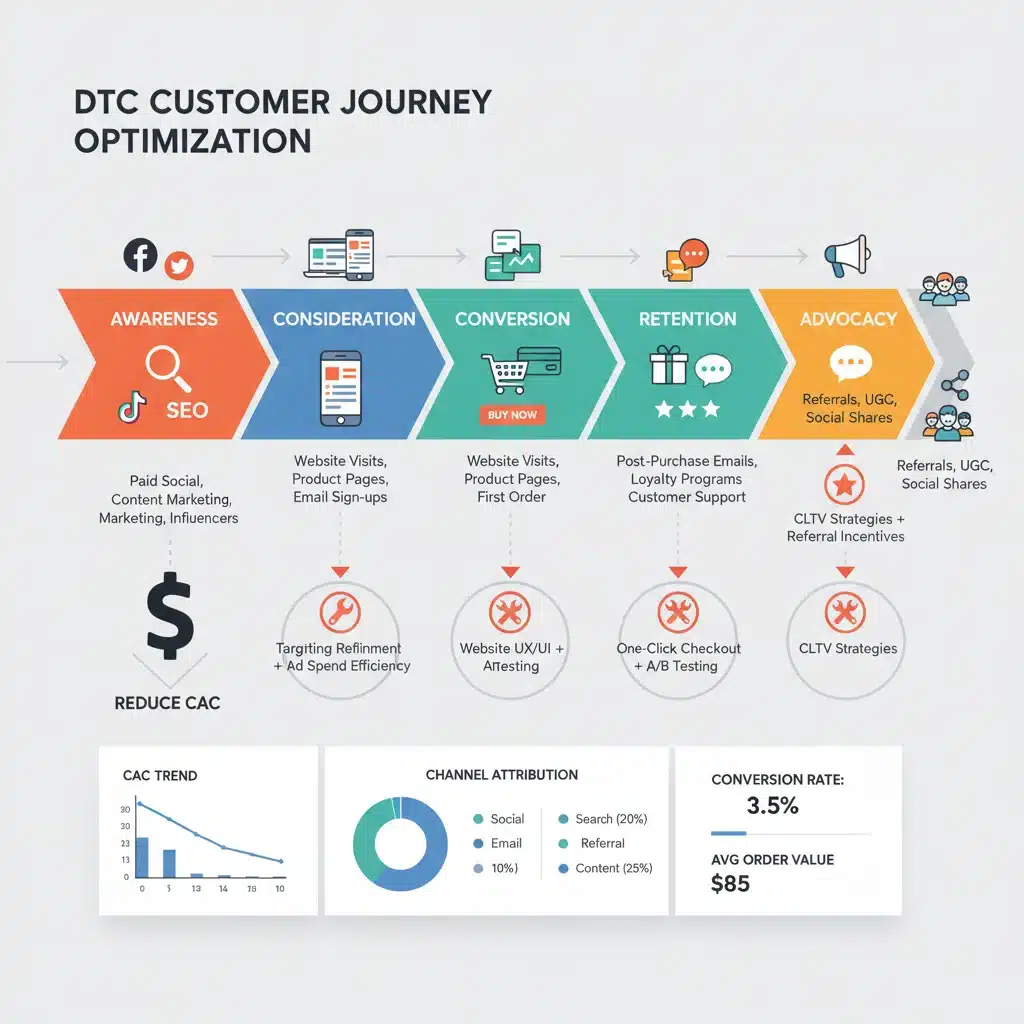
A leaky conversion funnel can negate even the most effective acquisition efforts. Streamlining the customer journey is critical for maximizing conversions from acquired traffic and, in turn, achieving significant DTC CAC reduction.
Seamless User Experience (UX) and Site Speed
Your website is your storefront. A clunky, slow, or confusing experience will drive potential customers away. Invest in:
- Mobile-first design: Most DTC traffic comes from mobile. Ensure your site is perfectly optimized for all mobile devices, from navigation to checkout.
- Lightning-fast load times: Every second counts. Optimize images, leverage caching, and choose a robust hosting provider. Google’s Core Web Vitals will continue to be a significant ranking factor.
- Intuitive navigation and clear calls to action (CTAs): Make it easy for customers to find what they’re looking for and take the desired action (e.g., ‘Add to Cart’, ‘Shop Now’).
- Personalized on-site experiences: Use AI to recommend products based on browsing history, past purchases, or even real-time behavior.
Conversion Rate Optimization (CRO) Across All Touchpoints
CRO is an ongoing process of improving your website and marketing assets to increase the percentage of visitors who complete a desired action. Key areas include:
- Landing page optimization: Ensure your landing pages are highly relevant to the ad that brought the user there. Use clear headlines, compelling visuals, social proof, and a strong, singular CTA. A/B test different elements to find what resonates best.
- Streamlined checkout process: Minimize steps, offer guest checkout options, provide multiple payment methods, and clearly display shipping costs upfront. Reduce friction at every stage to prevent cart abandonment.
- Effective pop-ups and exit-intent offers: Use strategically timed pop-ups for email sign-ups or exit-intent offers to capture leads or re-engage abandoning visitors.
- Leveraging social proof: Integrate customer reviews, testimonials, user-generated content (UGC), and influencer endorsements prominently on product pages and throughout the site.
Content Marketing for Organic Acquisition
Reducing reliance on paid channels is a direct path to DTC CAC reduction. High-quality content marketing can drive organic traffic and build brand authority.
- SEO-driven blog content: Create valuable, evergreen content that answers customer questions, solves problems, and showcases your expertise. Target long-tail keywords relevant to your niche.
- Video marketing: Short-form video (e.g., TikTok, Instagram Reels, YouTube Shorts) is a powerful tool for product demonstrations, behind-the-scenes content, and building personality.
- Educational resources: Guides, tutorials, and webinars can attract customers early in their journey and position your brand as a trusted resource.
- User-Generated Content (UGC): Encourage customers to share their experiences with your products. UGC is authentic, builds trust, and provides a continuous stream of fresh content for your marketing efforts.
Pillar 3: Building Community and Fostering Loyalty
Acquiring new customers is expensive; retaining existing ones is far more cost-effective. A strong focus on customer loyalty and community building is a powerful strategy for long-term DTC CAC reduction.
Exceptional Post-Purchase Experience
The customer journey doesn’t end at checkout. A positive post-purchase experience encourages repeat purchases and word-of-mouth referrals.
- Proactive communication: Keep customers informed about their order status, shipping, and delivery.
- Personalized follow-ups: Send thank-you notes, product care tips, or recommendations for complementary products.
- Hassle-free returns and customer service: Make returns easy and provide responsive, empathetic customer support.
- Loyalty programs: Implement tiered loyalty programs that reward customers for repeat purchases, referrals, and engagement.
Referral Programs and Word-of-Mouth Marketing
Referred customers often have a lower CAC and higher CLTV. Encourage your existing customer base to become advocates.
- Incentivize referrals: Offer attractive rewards for both the referrer and the referred customer (e.g., discounts, free products, exclusive access).
- Make sharing easy: Provide simple tools for customers to share their unique referral codes or links via email, social media, or messaging apps.
- Identify brand advocates: Engage with your most loyal customers and turn them into micro-influencers or brand ambassadors.
Cultivating a Brand Community
A strong brand community fosters a sense of belonging and can turn customers into passionate advocates, significantly lowering future acquisition costs.
- Online forums and groups: Create spaces (e.g., Facebook groups, Discord servers, dedicated forums) where customers can connect, share tips, and discuss your products.
- Exclusive content and events: Offer community members early access to new products, exclusive content, or virtual/in-person events.
- Listen and engage: Actively participate in community discussions, gather feedback, and show that you value their input. This builds trust and loyalty.

Pillar 4: Strategic Channel Diversification and Experimentation
In 2026, relying too heavily on one or two acquisition channels is a risky strategy. Diversifying your marketing mix and continuously experimenting with new channels is essential for sustainable DTC CAC reduction.
Exploring Emerging and Niche Platforms
While Facebook and Google remain powerful, their costs are rising. Look for opportunities on:
- TikTok and short-form video: Master creative, authentic content that resonates with these platforms’ audiences.
- Influencer marketing (micro and nano-influencers): Collaborate with smaller, highly engaged influencers whose audiences align perfectly with your target demographic. Their rates are often lower, and their authenticity drives higher engagement.
- Podcasts and audio advertising: Reach engaged listeners through targeted podcast sponsorships or audio ads.
- Affiliate marketing: Partner with relevant websites, bloggers, and content creators who can drive qualified traffic to your site on a performance-based model.
Leveraging Offline and Experiential Marketing
While DTC is primarily digital, strategic offline presence can create memorable experiences and drive online conversions, contributing to DTC CAC reduction by building brand equity.
- Pop-up shops and experiential events: Create immersive brand experiences that allow customers to interact with your products firsthand.
- Partnerships with complementary brands: Collaborate with non-competing brands for joint marketing campaigns, cross-promotions, or co-branded products.
- Direct mail (reimagined): High-quality, personalized direct mail can stand out in a crowded digital inbox, especially for high-value segments.
Testing and Iteration with a Growth Mindset
The marketing landscape changes rapidly. A continuous testing and iteration cycle is crucial.
- A/B testing everything: From ad creatives and landing pages to email subject lines and product descriptions.
- Small-scale experiments: Allocate a portion of your budget to testing new channels, audiences, and creative approaches without risking significant capital.
- Analyze and adapt: Rigorously track performance metrics, learn from your experiments (both successes and failures), and quickly adapt your strategies.
Pillar 5: Operational Efficiencies and Cost Management
Sometimes, DTC CAC reduction isn’t just about marketing spend, but about optimizing the underlying operational costs that indirectly impact your ability to invest in acquisition or your overall profitability.
Supply Chain Optimization
Efficient supply chain management can free up capital and reduce product costs, allowing for more strategic marketing investments or better pricing.
- Negotiate better supplier deals: Regularly review and negotiate terms with your manufacturers and suppliers.
- Optimize inventory management: Avoid overstocking (which ties up capital) and understocking (which leads to missed sales).
- Streamline logistics and fulfillment: Explore options for faster, more cost-effective shipping and warehousing solutions.
Automation and AI in Marketing Operations
Leverage technology to automate repetitive tasks, freeing up your team to focus on strategic initiatives.
- Marketing automation platforms: Automate email sequences, social media posting, and ad campaign adjustments.
- AI-powered ad optimization: Use AI tools to dynamically adjust bids, target audiences, and even generate ad copy.
- Chatbots for customer service: Automate responses to common customer queries, improving efficiency and customer satisfaction, which can indirectly lead to higher retention.
Team Training and Skill Development
An informed and skilled team is one of your biggest assets. Invest in:
- Data analytics training: Empower your marketing team to interpret data and make informed decisions.
- Creative development: Foster a culture of innovative content creation, as compelling creative is key to standing out without overspending.
- Understanding new technologies: Keep your team updated on the latest AI tools, platform changes, and marketing trends.
Measuring Success: Beyond the 10% CAC Reduction
While a 10% DTC CAC reduction is a clear goal, it’s essential to measure success holistically. Track metrics beyond just CAC:
- Customer Lifetime Value (CLTV): Ensure your efforts to reduce CAC aren’t sacrificing the quality of customers acquired.
- CAC:CLTV Ratio: Aim for a healthy ratio (e.g., 1:3 or better), indicating that the value a customer brings significantly outweighs the cost of acquiring them.
- Return on Ad Spend (ROAS): Monitor the direct revenue generated from your advertising efforts.
- Organic traffic and conversion rates: Track the growth of your organic channels as a sign of reduced reliance on paid acquisition.
- Brand sentiment and engagement: Qualitative metrics also matter. Are customers happy? Are they engaging with your brand?
Conclusion: A Strategic Imperative for 2026 and Beyond
Achieving a 10% DTC CAC reduction in the competitive 2026 market is an ambitious but attainable goal for DTC brands willing to embrace a forward-thinking, data-driven, and customer-centric approach. It requires moving beyond reactive campaign management to proactive strategic planning.
By harnessing first-party data for hyper-personalization, optimizing every stage of the customer journey, fostering strong community bonds, diversifying acquisition channels, and streamlining operations, DTC brands can not only reduce their acquisition costs but also build a more resilient, profitable, and customer-loved business. The brands that succeed in 2026 will be those that view CAC reduction not as a cost-cutting exercise, but as a strategic investment in sustainable growth and long-term customer relationships.
Start implementing these insider strategies today, and position your DTC brand for success in the dynamic years to come.