Headless Commerce Adoption: Boosting Page Load Speed by 40% for U.S. Retailers in 2026
In the fiercely competitive landscape of U.S. retail, where consumer expectations are constantly evolving, speed and agility are paramount. The digital storefront is often the first, and sometimes only, impression a brand makes. In this context, page load speed is not just a technical metric; it is a critical determinant of customer experience, conversion rates, and ultimately, a retailer’s bottom line. As we look towards 2026, a significant shift is underway: U.S. retailers are increasingly embracing headless commerce adoption as a strategic imperative, with the ambitious goal of boosting page load speed by an impressive 40%.
This comprehensive exploration delves into why headless commerce speed has become a non-negotiable advantage, the mechanisms through which it achieves such dramatic performance improvements, and the strategic considerations for U.S. retailers aiming to capitalize on this transformative technology. We will dissect the architectural nuances, the tangible benefits, the potential challenges, and the roadmap for successful implementation, all while keeping the focus on achieving a superior digital experience for the modern consumer.
The Imperative of Speed in Modern Retail
Before diving into the specifics of headless commerce adoption, it’s crucial to understand why page load speed is such a critical factor. In today’s instant-gratification society, patience is a dwindling commodity. Research consistently shows that even a one-second delay in page load time can lead to a significant drop in page views, customer satisfaction, and conversions. For U.S. retailers, this translates directly into lost revenue and diminished brand loyalty.
Impact on User Experience (UX)
A slow website frustrates users, leading to high bounce rates. When a page takes too long to load, potential customers are likely to abandon their shopping journey before it even begins. A fast-loading site, conversely, creates a seamless and enjoyable experience, encouraging users to explore more products, spend more time on the site, and complete their purchases. This positive UX is fundamental to building a strong customer relationship.
Influence on Conversion Rates
The correlation between page load speed and conversion rates is undeniable. Studies have shown that for every second shaved off load time, conversion rates can increase by several percentage points. For a large U.S. retailer, even a marginal improvement can translate into millions of dollars in additional sales annually. The pursuit of faster load times is, therefore, a direct investment in revenue growth.
SEO Advantages
Search engines like Google prioritize fast-loading websites in their ranking algorithms. A quicker site not only offers a better user experience but also signals to search engines that the site is high-quality and user-friendly. This can lead to higher search engine rankings, increased organic traffic, and greater visibility for U.S. retailers. Optimizing for headless commerce speed is thus a powerful SEO strategy.
Mobile-First Dominance
With a significant portion of online shopping now occurring on mobile devices, mobile page load speed has become even more critical. Mobile users often have less stable internet connections and higher expectations for instant access. Headless commerce, by its very nature, is ideally suited to deliver exceptional mobile performance, catering to the mobile-first consumer base.
What is Headless Commerce and Why is it Faster?
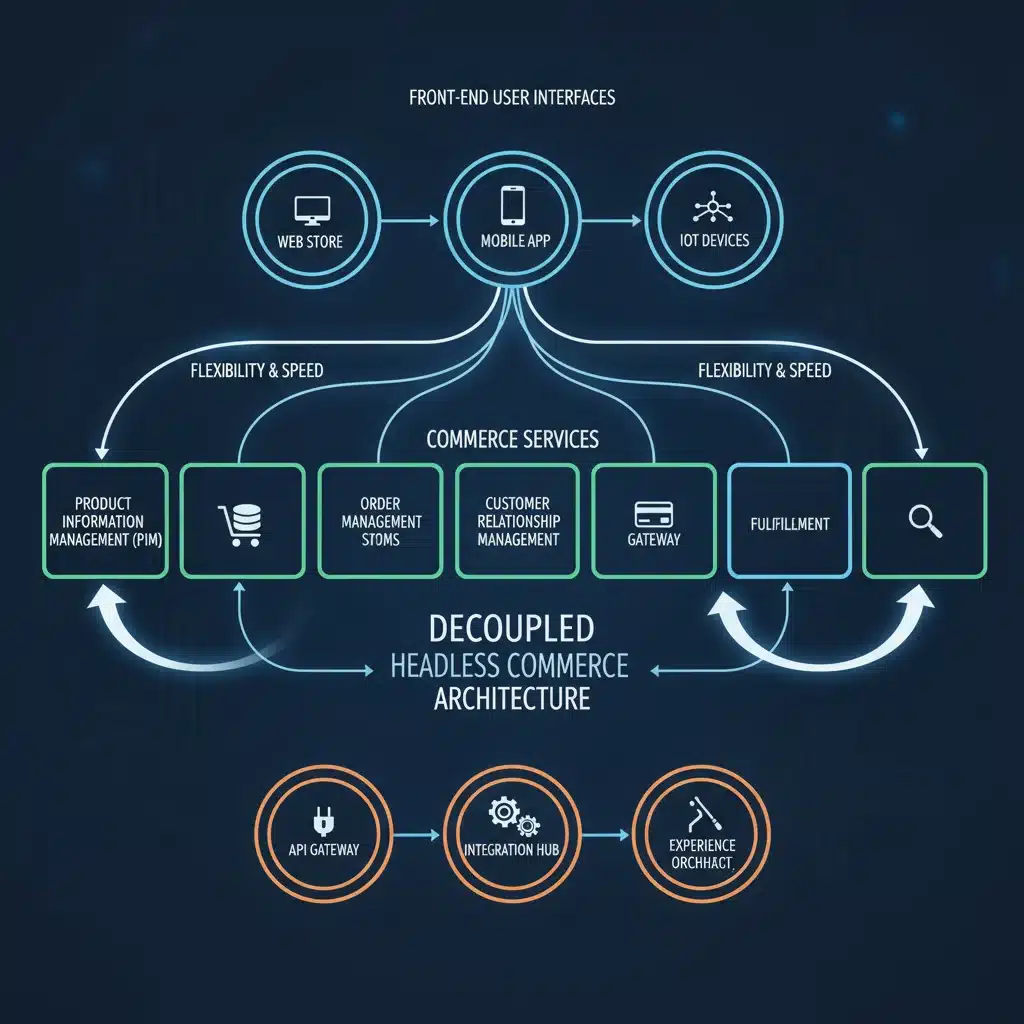
At its core, headless commerce is an architectural approach that decouples the front-end (the customer-facing presentation layer) from the back-end (the commerce engine, databases, and business logic). Unlike traditional monolithic commerce platforms where these layers are tightly integrated, headless commerce allows them to operate independently, communicating via APIs (Application Programming Interfaces).
The Monolithic Bottleneck vs. Headless Agility
Traditional monolithic platforms often struggle with speed because every change to the front-end requires modifications to the back-end, and vice-versa. This creates a heavy, complex system where updates are cumbersome, and performance optimization is challenging. The tightly coupled nature means that the entire system must render and process information for every page request, leading to slower load times.
Headless commerce adoption eliminates this bottleneck. By separating the front-end from the back-end, retailers gain unparalleled flexibility. The front-end can be built using modern, lightweight technologies (e.g., React, Vue, Angular) and optimized purely for speed and user experience, without being constrained by the back-end’s architecture. This is the fundamental reason for the significant boost in headless commerce speed.
How Decoupling Drives Performance
Several key factors contribute to the superior speed of headless commerce:
- Specialized Front-End Technologies: Developers can choose the best-of-breed front-end frameworks designed for performance and responsiveness. These frameworks are inherently faster at rendering content and handling user interactions.
- Reduced Server Load: The front-end can be hosted on a separate, often more efficient, server or CDN (Content Delivery Network). This offloads much of the rendering work from the commerce platform’s back-end, allowing it to focus solely on processing transactions and managing data.
- API-First Approach: APIs are designed for efficient data exchange. Instead of rendering entire pages, the front-end only requests the specific data it needs from the back-end, minimizing data transfer and processing overhead.
- Static Site Generation (SSG) and Server-Side Rendering (SSR): Headless architectures often leverage SSG or SSR for initial page loads, delivering fully rendered HTML to the browser quickly, before hydration with dynamic content. This provides an almost instant perceived load time.
- Microservices Architecture: Many headless solutions are built on a microservices foundation, where individual functionalities (e.g., product catalog, cart, checkout) are separate services. This allows for independent scaling and optimization of each component, preventing one slow service from dragging down the entire system.
Targeting a 40% Speed Boost by 2026: A Realistic Goal for U.S. Retailers
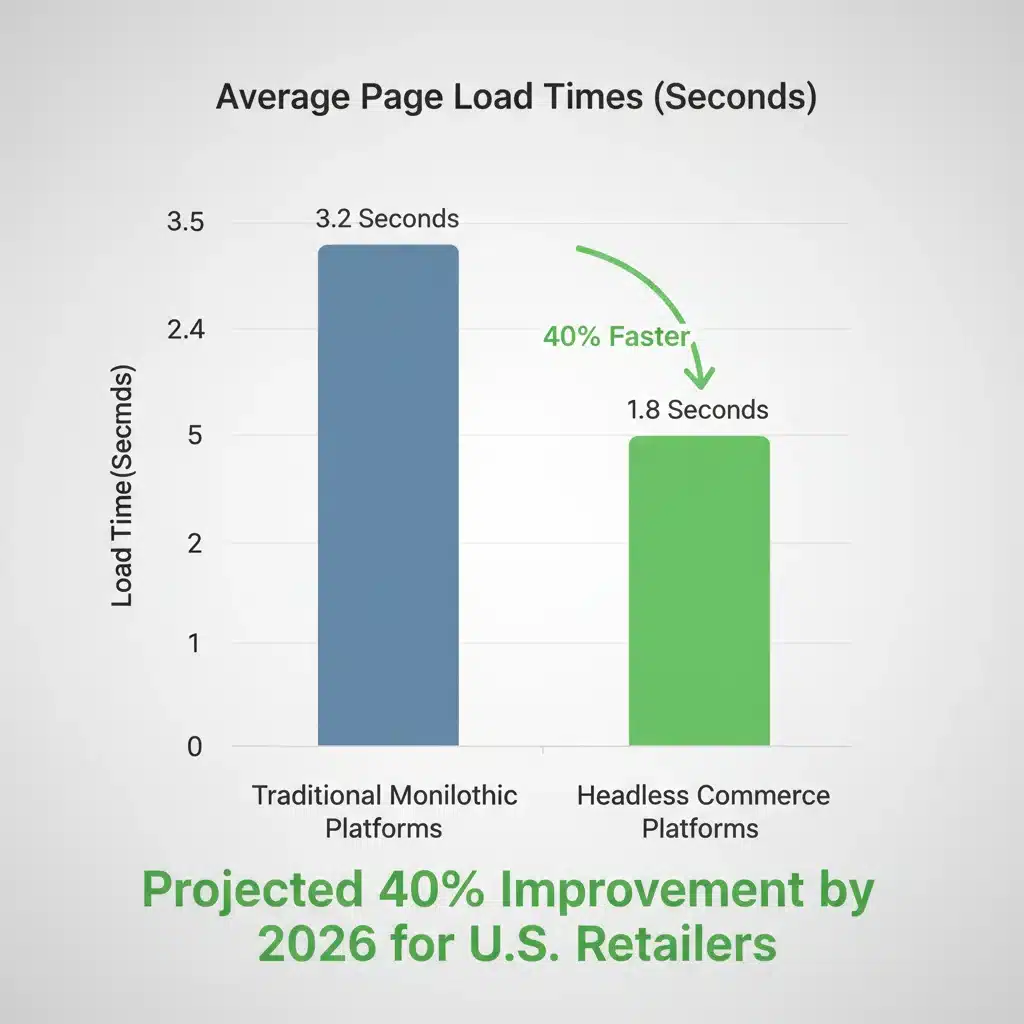
The ambition among U.S. retailers to achieve a 40% increase in page load speed through headless commerce adoption by 2026 is not merely aspirational; it is a tangible and achievable target. This goal is driven by several converging trends and advancements in technology.
Maturing Headless Ecosystem
The headless commerce ecosystem has matured significantly in recent years. A wide array of robust and specialized front-end frameworks, headless CMS (Content Management System) solutions, and API-first commerce platforms are now readily available. This maturity lowers the barrier to entry and provides retailers with proven tools to build high-performance experiences.
Increased Developer Expertise
The talent pool for developers proficient in modern front-end frameworks and API integrations is growing. This means that U.S. retailers have better access to the expertise needed to design, build, and optimize headless storefronts for maximum headless commerce speed.
Cloud Infrastructure and CDNs
The widespread adoption of cloud infrastructure and advanced Content Delivery Networks (CDNs) plays a crucial role. Cloud providers offer scalable, high-performance hosting environments, while CDNs strategically cache content closer to end-users, drastically reducing latency and load times, especially for geographically dispersed U.S. customers.
Competitive Pressure
The success stories of early adopters and digitally native brands that have already embraced headless architectures are creating significant competitive pressure. As more retailers experience the benefits of superior performance, others are compelled to follow suit to avoid being left behind in the race for customer attention and loyalty.
Strategic Implementation of Headless Commerce for U.S. Retailers
Achieving a 40% speed boost through headless commerce adoption requires a well-thought-out strategy. It’s not just about implementing new technology; it’s about a fundamental shift in how digital experiences are built and managed.
1. Assessment and Planning
- Current State Analysis: Evaluate existing commerce infrastructure, identify performance bottlenecks, and understand current page load metrics.
- Define Business Goals: Clearly articulate what a 40% speed increase means for key metrics (conversion rates, bounce rates, SEO rankings).
- Technology Stack Selection: Research and select appropriate front-end frameworks (e.g., Next.js, Nuxt.js), headless CMS, and API-driven commerce platforms that align with business needs and developer expertise.
2. Phased Rollout Approach
A big-bang approach can be risky. U.S. retailers should consider a phased rollout:
- Pilot Projects: Start with a smaller, less critical section of the website or a specific brand within the portfolio to test the headless architecture.
- Iterative Development: Continuously build, test, and optimize components, leveraging agile methodologies.
- Gradual Migration: Over time, migrate more functionalities and pages to the headless setup, ensuring a smooth transition for users.
3. Focus on Front-End Optimization
While the headless architecture provides the foundation for speed, meticulous front-end optimization is crucial for maximizing headless commerce speed:
- Image and Video Optimization: Compress images, use modern formats (WebP), implement lazy loading, and optimize video delivery.
- Code Splitting and Minification: Reduce the size of JavaScript, CSS, and HTML files.
- Browser Caching: Leverage browser caching to store static assets locally, speeding up subsequent visits.
- Critical CSS and Deferred JavaScript: Load only essential CSS first and defer non-critical JavaScript to improve initial render times.
4. API Performance and Management
The efficiency of API calls is central to headless commerce speed. Retailers must:
- Optimize API Endpoints: Ensure APIs are designed to return only necessary data efficiently.
- Implement API Caching: Cache frequently requested API responses to reduce redundant calls to the back-end.
- API Gateway Management: Utilize API gateways for security, rate limiting, and performance monitoring.
5. Leveraging CDNs and Edge Computing
For U.S. retailers serving a vast geographical area, CDNs are indispensable. They distribute content to servers located closer to users, significantly reducing latency. Edge computing further enhances this by performing computations closer to the data source, improving response times for dynamic content.
Measuring Success: Metrics for Speed Improvement
To confirm the 40% speed boost, U.S. retailers need robust measurement tools and metrics. Key performance indicators (KPIs) include:
- First Contentful Paint (FCP): Measures when the first piece of content (text, image) appears on the screen.
- Largest Contentful Paint (LCP): Measures when the largest content element in the viewport becomes visible. This is a crucial metric for perceived load speed.
- Time to Interactive (TTI): Measures when the page becomes fully interactive and responsive to user input.
- Cumulative Layout Shift (CLS): Measures the visual stability of a page.
- Total Blocking Time (TBT): Measures the total amount of time that a page is blocked from responding to user input.
- Bounce Rate: A decrease in bounce rate often correlates with improved speed.
- Conversion Rate: An increase in conversions is the ultimate business metric for success.
Regular monitoring and analysis of these metrics will provide clear insights into the effectiveness of headless commerce adoption and guide continuous optimization efforts.
Challenges and Considerations for U.S. Retailers
While the benefits of headless commerce speed are compelling, U.S. retailers must also be aware of potential challenges:
Increased Complexity
Decoupling introduces complexity. Managing multiple systems (front-end, back-end, CMS, PIM, etc.) that communicate via APIs requires robust integration strategies and skilled IT teams. The initial setup can be more involved than a traditional monolithic platform.
Higher Initial Cost
The upfront investment in headless commerce can be higher due to the need for specialized development talent, potentially new tools, and the architectural re-platforming effort. However, the long-term benefits in flexibility, scalability, and performance often outweigh these initial costs.
Talent Gap
Finding developers with expertise in modern front-end frameworks, API integration, and headless architecture can be a challenge. U.S. retailers may need to invest in training existing staff or recruiting new talent.
Vendor Management
A headless setup often means working with multiple vendors for different components (e.g., a commerce platform, a CMS, a search solution). Effective vendor management and ensuring seamless integration are critical.
SEO Considerations
While headless commerce can significantly boost SEO through speed, it also requires careful planning to ensure proper indexing and crawlability, especially when using client-side rendering. Implementing server-side rendering (SSR) or static site generation (SSG) is often recommended to mitigate these SEO risks.
The Future of Retail: Beyond Speed with Headless Commerce
Achieving a 40% boost in page load speed by 2026 through headless commerce adoption is a monumental achievement, but the benefits extend far beyond just speed. Headless commerce empowers U.S. retailers with:
Unmatched Flexibility and Agility
Retailers can quickly adapt to changing market trends, implement new features, and experiment with different user interfaces without disrupting the back-end. This agility is crucial for staying competitive in a dynamic market.
Omnichannel Experience
The API-first nature of headless commerce makes it ideal for delivering consistent and personalized experiences across all touchpoints – web, mobile apps, IoT devices, smart mirrors, voice assistants, and more. Retailers can use the same back-end commerce logic to power diverse front-end experiences, creating a true omnichannel strategy.
Personalization at Scale
With a decoupled architecture, it’s easier to integrate best-of-breed personalization engines and deliver highly tailored content and product recommendations based on individual customer behavior, further enhancing the customer journey.
Innovation and Experimentation
Headless commerce fosters a culture of innovation. Retailers can rapidly prototype and deploy new features, conduct A/B tests, and iterate on their digital experiences much faster than with monolithic platforms. This continuous improvement cycle is vital for long-term growth.
Conclusion: Embracing the Headless Revolution for a Faster Future
The journey for U.S. retailers towards a 40% increase in page load speed by 2026 is deeply intertwined with the strategic embrace of headless commerce adoption. This architectural paradigm shift is not merely a technical upgrade; it represents a fundamental rethinking of how digital retail experiences are crafted and delivered. By prioritizing headless commerce speed, retailers are making a crucial investment in customer satisfaction, conversion optimization, and long-term business resilience.
The benefits are clear: superior user experience, enhanced SEO, improved mobile performance, and the unparalleled flexibility to innovate and adapt. While challenges such as increased complexity and initial investment exist, the maturing ecosystem, growing talent pool, and proven success stories demonstrate that these hurdles are surmountable. For U.S. retailers looking to thrive in the digital age, headless commerce is no longer an option but a strategic imperative. The future of retail is fast, flexible, and customer-centric, and headless commerce is the engine driving this transformative evolution.