The ROI of RFID: Achieving 99% Inventory Accuracy and Reducing Shrinkage by 10% in Retail Operations for 2026

In the fiercely competitive landscape of modern retail, every percentage point of efficiency and accuracy can translate into millions of dollars in profit or loss. Retailers are constantly seeking innovative solutions to optimize operations, enhance customer experience, and safeguard their bottom line. Among the myriad of technological advancements, Radio-Frequency Identification (RFID) stands out as a game-changer, promising unprecedented levels of inventory accuracy and significant reductions in shrinkage. This article delves into the compelling return on investment (ROI) that RFID offers, specifically focusing on its potential to help retail operations achieve an astounding 99% inventory accuracy and a 10% reduction in shrinkage by 2026. We will explore the mechanisms through which RFID delivers these benefits, examine real-world applications, and provide a roadmap for successful implementation.
The ROI of RFID: Achieving 99% Inventory Accuracy and Reducing Shrinkage by 10% in Retail Operations for 2026
Understanding the Core Challenges in Retail Inventory Management
Before we dissect the transformative power of RFID, it’s crucial to understand the pervasive challenges that plague traditional retail inventory management. Manual inventory counts are notoriously time-consuming, labor-intensive, and prone to human error. This often leads to inaccurate stock levels, which in turn results in a cascade of problems:
- Out-of-Stocks: When inventory records show an item is available, but it’s not actually on the shelf, retailers lose sales and customer loyalty. This is a direct hit to revenue.
- Overstocks: Conversely, holding excess inventory ties up capital, incurs storage costs, and increases the risk of markdowns or obsolescence.
- Shrinkage: This refers to the loss of inventory due to theft (internal and external), administrative errors, damage, or vendor fraud. Shrinkage is a silent killer of retail profits, often accounting for 1-2% of sales, and sometimes even more.
- Inefficient Labor: Employees spend valuable time searching for items, conducting manual counts, and reconciling discrepancies, diverting them from customer-facing activities or more strategic tasks.
- Poor Customer Experience: Inaccurate inventory leads to frustrating experiences for customers who might be told an item is in stock only to find it unavailable, or vice-versa, leading to abandoned carts and negative perceptions.
These challenges collectively undermine operational efficiency and directly impact profitability. The goal of 99% inventory accuracy and a 10% reduction in shrinkage by 2026 is not merely ambitious; it’s a strategic imperative for retailers aiming to thrive in an increasingly competitive market.
How RFID Technology Revolutionizes Inventory Accuracy
RFID technology utilizes radio waves to automatically identify and track tags attached to objects. Unlike barcodes, RFID tags do not require line-of-sight scanning and can be read rapidly in bulk, even through packaging or from a distance. This fundamental difference is what makes RFID a game-changer for inventory accuracy.
Real-Time Visibility and Granular Data
With RFID, every individual item in a store or warehouse can be tagged. Handheld or fixed RFID readers can then scan hundreds of items per second, providing real-time, item-level visibility into stock. This means:
- Precise Stock Counts: Retailers can conduct full store inventory counts in a fraction of the time it takes with traditional methods, and with significantly higher accuracy. Some retailers report achieving 95-99% accuracy rates, a monumental improvement over typical barcode-based systems that often hover around 65-75%.
- Location Tracking: RFID can not only tell you what you have but also where it is. This is invaluable for locating misplaced items, streamlining replenishment, and optimizing store layouts.
- Automated Receiving and Shipping: Goods equipped with RFID tags can be automatically counted as they enter or leave a distribution center or store, drastically reducing human error and processing time.
- Enhanced Omnichannel Fulfillment: Accurate, real-time inventory data is the bedrock of successful omnichannel strategies. It enables retailers to confidently offer services like Buy Online, Pick Up In Store (BOPIS), ship from store, and online order fulfillment, knowing exactly what stock is available at each location.
Achieving 99% inventory accuracy is not just a theoretical possibility with RFID; it’s a proven outcome for many early adopters. This level of precision virtually eliminates out-of-stocks caused by inaccurate records, ensuring that products are always available when and where customers want them.
Combatting Shrinkage with RFID: A 10% Reduction Target
Shrinkage is a multifaceted problem, but RFID offers powerful tools to address its various causes, making a 10% reduction by 2026 a highly attainable goal. The technology tackles both external and internal theft, as well as administrative errors.
Deterring Theft and Improving Security
- Enhanced Electronic Article Surveillance (EAS): RFID tags can double as EAS tags. If an item leaves the store without being properly deactivated at the point of sale, an alarm will sound. This is far more effective than traditional EAS systems because RFID can identify the specific item being stolen, providing valuable data for loss prevention.
- Item-Level Tracking: The ability to track individual items through the supply chain and within the store makes it much harder for employees or external actors to divert merchandise without detection. Discrepancies between expected inventory and actual inventory become immediately apparent.
- Reduced Internal Theft: By providing a clear audit trail for every item, RFID makes it more difficult for employees to engage in theft or fraudulent returns, as each item’s journey can be meticulously monitored.
Minimizing Administrative Errors
A significant portion of shrinkage is not due to theft but to administrative errors, such as mis-shipments, incorrect receiving, or data entry mistakes. RFID automates many of these processes, dramatically reducing the potential for error:
- Automated Verification: When a shipment arrives, RFID readers can automatically verify that the correct items and quantities have been received against the purchase order, flagging any discrepancies instantly.
- Streamlined Returns: RFID can expedite the returns process by quickly identifying items and verifying their purchase, reducing instances of fraudulent returns or errors in restocking.
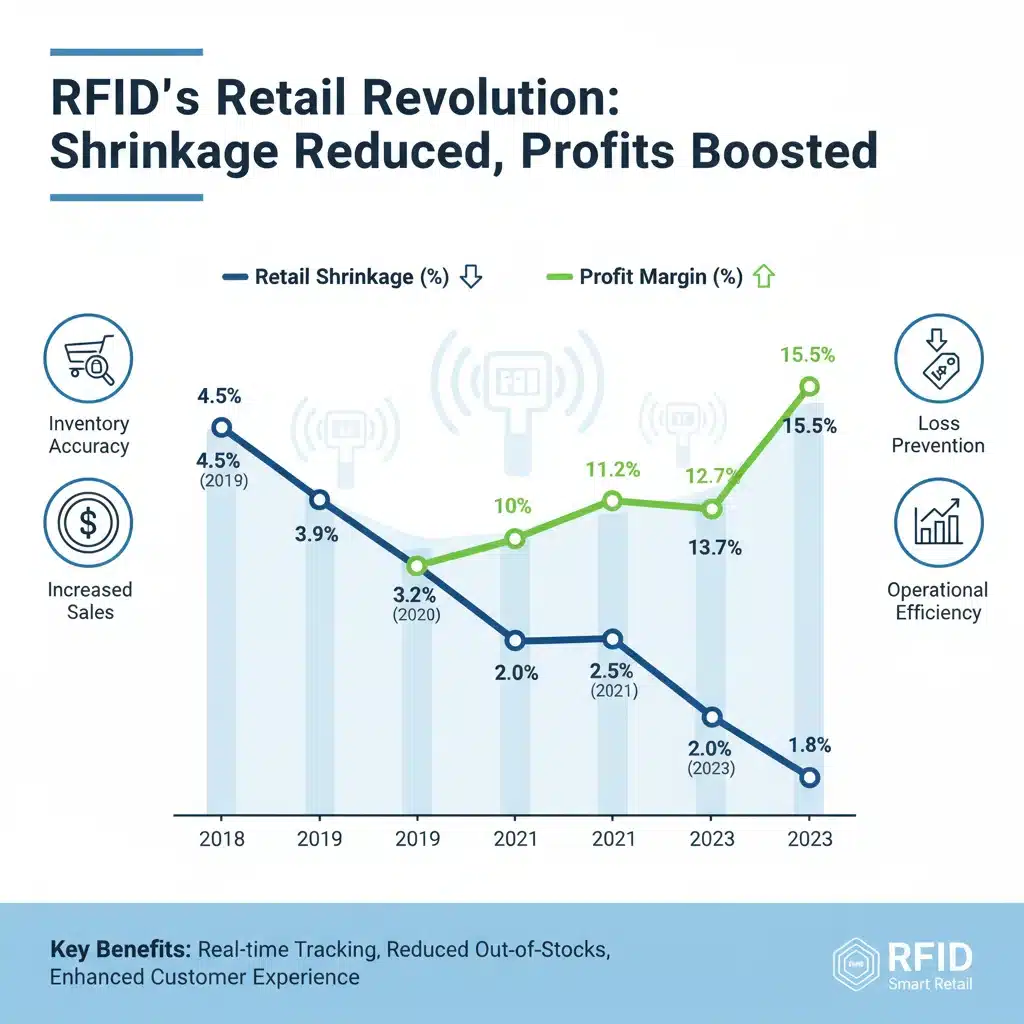
By addressing these key areas, RFID provides a robust defense against shrinkage. A 10% reduction in shrinkage, while ambitious, is entirely feasible given the comprehensive visibility and control that RFID offers. For a retailer with $100 million in annual sales and a 1.5% shrinkage rate, a 10% reduction means saving $150,000 annually – a significant boost to the bottom line.

Calculating the ROI of RFID in Retail
The ROI of RFID in retail is multifaceted, encompassing both direct cost savings and indirect benefits that enhance overall business performance. To truly understand the value, consider the following:
Direct Financial Benefits
- Increased Sales from Improved Availability: With 99% inventory accuracy, out-of-stocks are minimized, leading to more sales. A conservative estimate often places this sales uplift at 2-5%.
- Reduced Shrinkage Costs: As discussed, a 10% reduction in shrinkage directly translates to savings on lost merchandise.
- Lower Labor Costs: Automation of inventory counts, receiving, and searching for items frees up staff time, which can be reallocated to customer service or other value-added tasks. This can lead to significant labor cost savings or improved productivity without additional hires.
- Optimized Inventory Levels: Better accuracy allows for more precise ordering, reducing overstock situations, carrying costs, and the need for markdowns.
- Reduced Stock-outs of Promotional Items: Ensuring availability of advertised products maximizes the impact of marketing campaigns.
Indirect Strategic Benefits
- Enhanced Customer Experience: Customers benefit from consistent product availability, faster service, and accurate information, leading to increased satisfaction and loyalty.
- Improved Operational Efficiency: Streamlined processes across the supply chain, from warehouse to store floor, lead to smoother operations and faster fulfillment.
- Better Data for Decision Making: Granular, real-time data provides invaluable insights into product movement, sales patterns, and inventory health, enabling more informed business decisions.
- Competitive Advantage: Retailers adopting RFID gain a significant edge over competitors still grappling with traditional, less efficient inventory systems.
- Sustainability: Optimized inventory reduces waste from overproduction and obsolescence, contributing to more sustainable retail practices.
While initial implementation costs for RFID can be substantial (tags, readers, software integration), the rapid payback period and ongoing benefits often justify the investment. Many studies and real-world case studies show ROI achieved within 12-24 months, driven primarily by increased sales and reduced shrinkage.
Key Considerations for Successful RFID Implementation
Achieving the targeted 99% inventory accuracy and 10% shrinkage reduction by 2026 requires careful planning and execution. Here are critical factors for a successful RFID deployment:
1. Pilot Program and Scalability
Start with a pilot program in a single store or department to test the technology, identify potential challenges, and fine-tune processes. This allows for a controlled environment to gather data and build a strong business case before scaling across the entire enterprise.
2. Tagging Strategy
Decide on item-level tagging versus case-level tagging. For maximum accuracy and shrinkage reduction, item-level tagging is ideal, though it requires a robust tagging process, either at the source (manufacturer) or in the distribution center/store.
3. Infrastructure and Hardware
Invest in reliable RFID readers (handheld, fixed, or overhead), antennas, and printers for tags. The quality and placement of this infrastructure are crucial for optimal read rates and data capture.
4. Software Integration
RFID data is only as valuable as the system that interprets it. Seamless integration with existing Enterprise Resource Planning (ERP), Point of Sale (POS), and Warehouse Management Systems (WMS) is paramount. This ensures that RFID data flows directly into your core business intelligence systems.
5. Staff Training and Adoption
Employee buy-in is critical. Comprehensive training on how to use RFID readers, understand the new processes, and leverage the data is essential. Highlight the benefits to them, such as reduced manual workload and easier task completion.
6. Data Analytics and Continuous Improvement
Implement strong analytics tools to continuously monitor RFID performance, identify areas for improvement, and measure the ongoing ROI. The data generated by RFID is a goldmine for optimizing operations further.
Real-World Impact and Future Outlook
Leading retailers across various sectors – from apparel and footwear to electronics and groceries – have already demonstrated the profound impact of RFID. Companies like Zara, Macy’s, and Decathlon have publicly shared their successes, reporting significant improvements in inventory accuracy, reductions in out-of-stocks, and notable decreases in shrinkage.
For instance, Zara famously achieved near 98% inventory accuracy, enabling them to respond with unprecedented agility to fashion trends and customer demand. Decathlon leveraged RFID to streamline their entire supply chain, from manufacturing to in-store experience, leading to massive efficiency gains.
Looking ahead to 2026, the adoption of RFID is expected to accelerate. As the cost of tags decreases and the technology becomes more refined, it will become an indispensable tool for any retailer serious about optimizing their operations and maximizing profitability. The drive towards omnichannel retail and the increasing consumer expectation for immediate availability further solidify RFID’s position as a foundational technology.
Moreover, the integration of RFID with other emerging technologies, such as artificial intelligence (AI) and machine learning (ML), promises even greater insights and automation. Imagine AI-powered systems that predict potential shrinkage hot spots based on RFID data or dynamically adjust inventory levels based on real-time foot traffic and sales patterns.
Conclusion: The Undeniable Case for RFID in Retail
The goal of achieving 99% inventory accuracy and a 10% reduction in shrinkage by 2026 is not just an aspiration; it’s a strategic imperative that RFID technology is uniquely positioned to deliver. By providing unparalleled item-level visibility, automating laborious processes, and bolstering loss prevention efforts, RFID offers a compelling ROI that directly impacts a retailer’s top and bottom lines.
The benefits extend beyond mere cost savings, encompassing enhanced customer satisfaction, improved operational efficiency, and a stronger competitive stance in the market. While the journey to full RFID integration requires careful planning and investment, the proven successes of early adopters and the clear trajectory of technological advancement make the case for RFID in retail undeniable. Retailers who embrace this technology now will be well-positioned to navigate the complexities of the future, ensuring profitability and sustained growth in an ever-evolving industry.
Embracing RFID is not just about adopting a new technology; it’s about fundamentally transforming how retail inventory is managed, secured, and leveraged to create a superior shopping experience and a more resilient, profitable business. The time to invest in RFID for your retail operations is now, to unlock its full potential by 2026 and beyond.