Privacy-First E-commerce: Adapting for U.S. Data Regulations 2026
Privacy-First E-commerce: Adapting Your Strategy for U.S. Data Regulations in 2026 to Ensure 100% Compliance
The digital landscape is in constant flux, and for e-commerce businesses, perhaps no area is evolving as rapidly – and with as much consequence – as data privacy. As we inch closer to 2026, the United States is witnessing a significant shift towards more comprehensive and stringent data protection laws. This isn’t merely a legal hurdle; it’s a fundamental redefinition of how online businesses interact with, collect, store, and utilize consumer data. Embracing a e-commerce data compliance strategy that is ‘privacy-first’ is no longer optional; it’s a critical imperative for survival and growth.
For years, e-commerce benefited from a relatively unrestricted environment for data collection. However, the rise of high-profile data breaches, growing consumer awareness, and the influence of international benchmarks like GDPR have spurred U.S. states to act. What began with California’s CCPA has expanded into a patchwork of state-level regulations, all pointing towards a potential federal standard or a highly complex compliance environment by 2026. This article will delve into the intricacies of these impending changes, offering a comprehensive guide to help your e-commerce business not just adapt, but thrive, through robust e-commerce data compliance.
Our goal is to equip you with the knowledge and actionable strategies to achieve 100% compliance, build unwavering customer trust, and future-proof your online operations. From understanding the core principles of privacy-by-design to implementing cutting-edge data security measures, we’ll explore every facet of this transformative journey. Prepare to transform your approach to customer data, turning potential challenges into significant competitive advantages.
The Evolving Landscape of U.S. Data Regulations for E-commerce
Before charting a path to compliance, it’s crucial to understand the regulatory terrain. While the U.S. currently lacks a single, overarching federal data privacy law comparable to the EU’s GDPR, the trend is undeniably moving in that direction. Several states have enacted their own comprehensive privacy statutes, creating a complex web of requirements for businesses operating nationwide. By 2026, we can anticipate either a federal framework or a more harmonized, yet still multi-faceted, state-level approach that demands vigilant e-commerce data compliance.
Key State-Level Regulations and Their Impact
- California Consumer Privacy Act (CCPA) and California Privacy Rights Act (CPRA): The trailblazers in U.S. data privacy, CCPA, and its successor CPRA, grant California consumers significant rights over their personal information. This includes the right to know what data is collected, to delete it, and to opt-out of its sale or sharing. For e-commerce, this means transparent data practices, easy-to-use opt-out mechanisms, and robust data mapping.
- Virginia Consumer Data Protection Act (VCDPA): Similar to CCPA/CPRA, VCDPA provides consumers with rights to access, delete, and opt-out of the processing of their personal data for targeted advertising, sale, or profiling. It emphasizes the need for clear privacy notices and data protection assessments for high-risk processing activities.
- Colorado Privacy Act (CPA): The CPA also grants consumers rights regarding their personal data, including the right to opt-out of targeted advertising and the sale of personal data. It imposes duties on controllers to minimize data collection, conduct data protection assessments, and obtain consent for sensitive data.
- Utah Consumer Privacy Act (UCPA): While providing similar consumer rights, UCPA takes a slightly different approach, often seen as more business-friendly in some aspects, but still requiring significant commitment to transparency and consumer control.
- Connecticut Data Privacy Act (CTDPA): This act mirrors many provisions of other state laws, granting rights to access, correct, delete, and obtain copies of personal data, as well as the right to opt-out of the sale of personal data and targeted advertising.
The proliferation of these laws means that an e-commerce business serving customers across the U.S. must potentially comply with multiple, sometimes conflicting, sets of regulations. This fragmentation makes achieving comprehensive e-commerce data compliance a substantial challenge, necessitating a strategy that anticipates future consolidation or further diversification.
Anticipating Federal Legislation and Future Trends
The ongoing discussions in Congress regarding a federal data privacy law suggest that a unified standard could emerge by 2026. Such legislation would likely preempt many state laws, simplifying compliance for businesses but potentially introducing a new, more rigorous baseline. Key themes expected in any federal law include:
- Universal Consumer Rights: A consistent set of rights for all U.S. consumers, including access, deletion, correction, and opt-out.
- Data Minimization: The principle that businesses should only collect data that is strictly necessary for their stated purpose.
- Purpose Limitation: Data collected for one purpose should not be used for another without explicit consent.
- Enhanced Security Requirements: Mandates for robust technical and organizational measures to protect personal data.
- Accountability: Requirements for businesses to demonstrate compliance, potentially through data protection officers or regular audits.
Understanding these trends is vital for proactive planning. By building a privacy-first framework now, e-commerce businesses can position themselves to easily adapt to future legislative changes, whether federal or state-driven, ensuring continuous e-commerce data compliance.
Pillars of a Privacy-First E-commerce Strategy
A privacy-first approach goes beyond mere legal adherence; it embeds data protection into the very fabric of your business operations. It’s about building trust, enhancing customer loyalty, and ultimately, creating a more sustainable and ethical e-commerce ecosystem. Here are the foundational pillars:
1. Data Mapping and Inventory: Knowing Your Data
You can’t protect what you don’t know you have. The first step towards robust e-commerce data compliance is a comprehensive data mapping exercise. This involves:
- Identifying all personal data collected: From customer names and addresses to IP addresses, browsing history, payment information, and even social media interactions.
- Understanding where data is stored: Across your e-commerce platform, CRM, marketing automation tools, analytics platforms, and third-party integrations.
- Documenting data flows: How data moves within your organization and with third-party vendors.
- Defining the purpose of collection: For each piece of data, articulate why it’s being collected and how it’s used.
- Assessing data retention periods: How long is data kept, and is it justifiable?
A detailed data inventory provides the clarity needed to identify compliance gaps, implement data minimization strategies, and respond effectively to data subject access requests (DSARs). Tools and frameworks exist to assist with this complex process, transforming it from a daunting task into a manageable project.
2. Consent Management and Transparency: Empowering Your Customers
Central to privacy regulations is the concept of consent. Consumers must be given clear, unambiguous choices about how their data is used. For e-commerce, this translates to:
- Clear and concise privacy policies: Written in plain language, easily accessible, and regularly updated to reflect data practices.
- Granular cookie consent banners: Allowing users to accept, reject, or customize their cookie preferences beyond just essential cookies.
- Opt-in for marketing communications: Moving away from pre-checked boxes and ensuring explicit consent for newsletters, promotional emails, and personalized advertising.
- Easy-to-understand terms of service: Outlining data usage in an accessible format.
- Preference centers: Giving customers a central hub to manage their data preferences and communication settings.
Transparency builds trust. When customers feel in control of their data, they are more likely to engage with your brand and provide the data necessary for a personalized shopping experience, all while maintaining strong e-commerce data compliance.
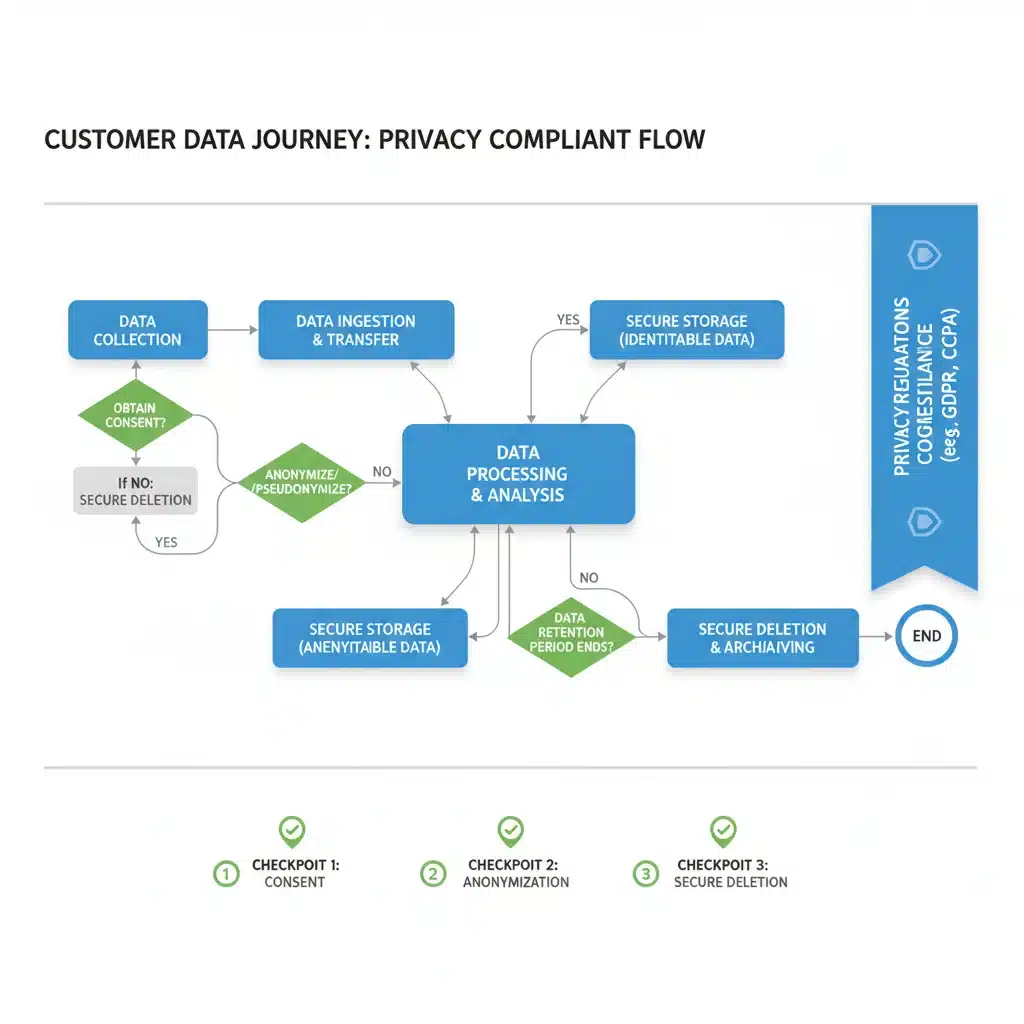
3. Data Minimization and Anonymization: Less is More
The principle of data minimization dictates that businesses should only collect and retain the data absolutely necessary to fulfill a specific, legitimate purpose. This reduces the risk associated with data breaches and simplifies compliance. Strategies include:
- Reviewing data collection forms: Eliminate unnecessary fields. Do you really need a customer’s birthdate for a basic purchase?
- Regular data purging: Implement policies to delete or anonymize data that is no longer needed for its original purpose or legally required retention period.
- Anonymization and pseudonymization: Where possible, transform personal data so it cannot be attributed to a specific individual without additional information. This is particularly useful for analytics and research.
- Limiting access: Restrict internal access to personal data to only those employees who absolutely require it for their job functions.
By collecting less data and retaining it for shorter periods, you significantly reduce your attack surface and compliance burden, strengthening your overall e-commerce data compliance posture.
4. Robust Data Security Measures: Protecting What You Have
Even with data minimization, the personal data you do collect must be rigorously protected. A data breach can be devastating, leading to financial penalties, reputational damage, and loss of customer trust. Essential security measures include:
- Encryption: Encrypt data both in transit (e.g., SSL/TLS for website traffic) and at rest (e.g., encrypted databases).
- Access controls: Implement strong authentication (MFA), role-based access, and regular access reviews.
- Regular security audits and penetration testing: Proactively identify vulnerabilities in your systems.
- Vendor due diligence: Ensure all third-party vendors (payment processors, marketing platforms, cloud providers) also adhere to stringent security standards.
- Incident response plan: Develop and regularly test a plan for how to detect, respond to, and recover from a data breach, including notification procedures.
- Employee training: Educate all staff on data privacy best practices and security awareness.
Implementing these security measures is not a one-time task but an ongoing commitment to safeguarding customer information and ensuring continuous e-commerce data compliance.
Implementing Your Privacy-First Strategy: Practical Steps
Transitioning to a privacy-first model requires a structured approach. Here are practical steps to integrate these principles into your e-commerce operations:
1. Update Your Privacy Policy and Terms of Service
This is often the first point of contact for customers regarding your data practices. Ensure your privacy policy is:
- Comprehensive: Clearly state what data you collect, why, how it’s used, who it’s shared with, and for how long.
- User-friendly: Avoid legal jargon. Use clear headings, bullet points, and a searchable format.
- Accessible: Prominently display links to your privacy policy on your website, especially at points of data collection (e.g., checkout, registration).
- Up-to-date: Review and update it regularly, especially when there are changes in data practices or regulations.
Your terms of service should also reflect your commitment to data privacy, outlining customer rights and your responsibilities. These documents are fundamental to establishing trust and demonstrating e-commerce data compliance.
2. Enhance Consent Mechanisms
Go beyond basic checkboxes. Implement sophisticated consent management platforms (CMPs) that allow users fine-grained control over their data. This includes:
- Cookie preference centers: Categorize cookies (essential, analytical, marketing) and allow users to opt-in or out for each category.
- Explicit consent for non-essential data: For any data not strictly necessary for the service, obtain clear, affirmative consent.
- Record keeping: Maintain records of consent, including when and how it was given, to demonstrate compliance.
- Easy withdrawal of consent: Make it as easy for users to withdraw consent as it was to give it.
These enhancements not only ensure compliance but also build a positive customer experience, reinforcing the perception of your brand as trustworthy and privacy-conscious.
3. Streamline Data Subject Access Request (DSAR) Fulfillment
Consumers have the right to access, correct, delete, and port their personal data. Your e-commerce business must have efficient processes in place to handle these requests:
- Designated contact point: Provide a clear email address or web form for DSAR submissions.
- Verification process: Implement secure methods to verify the identity of the requester to prevent unauthorized access.
- Internal procedures: Establish workflows for locating, compiling, and delivering the requested data within the legally mandated timeframe (e.g., 30-45 days).
- Deletion protocols: Ensure that when a deletion request is made, data is removed from all relevant systems and backups, while also maintaining records of the deletion for audit purposes.
Failure to respond to DSARs promptly and accurately can lead to significant penalties, making streamlined DSAR fulfillment a critical component of e-commerce data compliance.
4. Vet Third-Party Vendors and Integrations
Your privacy posture is only as strong as your weakest link. Every third-party service integrated with your e-commerce platform – from payment gateways and analytics tools to marketing automation and shipping providers – handles customer data. Therefore, rigorous vendor management is essential:
- Due diligence: Before engaging a vendor, assess their data privacy and security practices.
- Data Processing Agreements (DPAs): Ensure all contracts with vendors include robust DPAs that outline their responsibilities for data protection and compliance.
- Regular audits: Periodically review vendor compliance and performance.
- Data sharing agreements: Clearly define what data is shared, why, and how it will be protected.
A comprehensive vendor management program minimizes your exposure to third-party data breaches and strengthens your overall e-commerce data compliance framework.
5. Invest in Privacy-Enhancing Technologies (PETs)
Technology can be a powerful ally in your privacy-first journey. PETs are tools and techniques designed to protect personal data while still allowing for its analysis and use. Examples include:
- Differential Privacy: Adds statistical noise to data to obscure individual records while maintaining overall data utility for analysis.
- Homomorphic Encryption: Allows computations to be performed on encrypted data without decrypting it first.
- Secure Multi-Party Computation (SMC): Enables multiple parties to jointly compute a function over their inputs while keeping those inputs private.
- Federated Learning: Trains AI models on decentralized datasets without the need to centralize raw data.
While some PETs are still emerging, exploring their potential can offer innovative ways to leverage data for insights and personalization without compromising individual privacy, pushing the boundaries of e-commerce data compliance.

Benefits Beyond Compliance: Building Customer Trust and Brand Loyalty
While avoiding penalties is a significant motivator for e-commerce data compliance, the benefits of a privacy-first strategy extend far beyond mere legal adherence. In today’s digital economy, trust is the new currency, and a strong commitment to privacy can be a powerful differentiator.
Enhanced Brand Reputation and Customer Loyalty
Consumers are increasingly aware of their data rights and are more likely to support businesses that demonstrate respect for their privacy. A transparent, privacy-first approach fosters trust, which in turn leads to:
- Increased customer retention: Loyal customers are less likely to switch to competitors.
- Positive word-of-mouth: Satisfied customers become advocates for your brand.
- Higher conversion rates: Customers are more willing to complete purchases when they feel their data is safe.
- Stronger brand equity: Your brand becomes associated with integrity and ethical practices.
In a crowded e-commerce market, standing out as a privacy champion can provide a significant competitive edge.
Improved Data Quality and Business Insights
When customers willingly provide data because they trust you, the quality of that data often improves. Opt-in data tends to be more accurate and relevant, leading to:
- More effective marketing campaigns: Targeted advertising based on explicit consent performs better.
- Better product development: Insights derived from consented data can lead to more relevant product offerings.
- Reduced data clutter: Focusing on necessary data means less irrelevant information to manage and secure.
A privacy-first approach encourages a more thoughtful and strategic use of data, ultimately yielding better business outcomes and reinforcing e-commerce data compliance as a business asset.
Future-Proofing Your Business
The trajectory of data privacy regulations is clear: they are becoming more comprehensive and globally interconnected. By proactively adopting a privacy-first strategy now, you are:
- Anticipating future regulations: Building a flexible framework that can easily adapt to new laws.
- Reducing compliance costs: Proactive measures are often less expensive than reactive fixes after a breach or regulatory action.
- Expanding market reach: Compliance with U.S. regulations often aligns with international standards, facilitating expansion into new markets.
Investing in privacy is an investment in the long-term resilience and adaptability of your e-commerce business, ensuring sustained e-commerce data compliance.
Challenges and How to Overcome Them
While the benefits are clear, implementing a privacy-first strategy for e-commerce data compliance comes with its own set of challenges. Recognizing these and planning for them is key to successful adoption.
Complexity of Regulatory Landscape
The fragmented nature of U.S. state laws, coupled with the potential for federal legislation, can be overwhelming. To overcome this:
- Adopt a highest common denominator approach: Aim for compliance with the strictest regulations (e.g., CPRA, GDPR principles) to cover most, if not all, requirements.
- Leverage legal counsel: Engage attorneys specializing in data privacy to navigate the nuances and stay updated on legislative changes.
- Utilize compliance software: Invest in tools that help manage consent, DSARs, and data mapping across multiple jurisdictions.
Resource Constraints
Small to medium-sized e-commerce businesses may struggle with the resources (time, money, expertise) required for full compliance. Strategies include:
- Phased implementation: Prioritize critical areas (e.g., privacy policy, consent for essential data) and gradually expand.
- Outsourcing: Consider specialized privacy consultants or managed compliance services.
- Leveraging platform features: Many e-commerce platforms offer built-in privacy tools and integrations.
Balancing Personalization with Privacy
A common concern is that strict privacy measures will hinder personalization efforts, a cornerstone of modern e-commerce. However, this is a false dilemma. By focusing on consented, high-quality data, you can achieve even more effective personalization:
- Contextual advertising: Use non-personal data (e.g., current page content) for relevant ads.
- First-party data focus: Prioritize data collected directly from customers with their consent, which is often more valuable and privacy-compliant.
- Aggregate insights: Utilize anonymized data for trend analysis without identifying individuals.
The goal is smart personalization, not intrusive personalization, ensuring e-commerce data compliance.
Conclusion: Your Path to 100% E-commerce Data Compliance by 2026
The journey to 100% e-commerce data compliance by 2026 is a significant undertaking, but it is one that promises substantial returns. The evolving U.S. data regulation landscape is not a threat to be feared, but an opportunity to redefine your relationship with customers, build a stronger brand, and future-proof your business in an increasingly data-conscious world.
By embracing a privacy-first mindset – one that prioritizes transparency, consumer control, data minimization, and robust security – your e-commerce operation can transform potential liabilities into powerful assets. Start with a thorough data inventory, refine your consent mechanisms, secure your data diligently, and engage with your customers as partners in data stewardship. The businesses that lead with privacy today will be the ones that command trust and loyalty tomorrow.
Don’t wait for deadlines to loom or enforcement actions to hit. Begin your comprehensive privacy review and strategic adaptation now. The future of e-commerce is privacy-first, and those who embrace this reality will not only comply with regulations but also flourish in an era where consumer trust is paramount. Your commitment to e-commerce data compliance is not just a legal necessity; it’s a strategic imperative for sustainable success.