Headless Commerce Roadmap: 6 Months to 25% Faster Site Speed for US Retailers

Implementing Headless Commerce: A 6-Month Roadmap for US Retailers to Achieve a 25% Faster Site Speed in 2026
In the fiercely competitive landscape of US retail, delivering an exceptional online experience is no longer a luxury but a fundamental necessity. Consumers demand speed, personalization, and seamless interactions across all touchpoints. Traditional monolithic e-commerce platforms, while robust, often struggle to keep pace with these evolving demands, leading to sluggish site speeds, limited agility, and ultimately, lost sales. This is where headless commerce roadmap strategies emerge as a game-changer.
For US retailers aiming to future-proof their digital presence and significantly enhance customer experience, embracing headless commerce is a strategic imperative. This article outlines a comprehensive 6-month headless commerce roadmap designed to guide US retailers through a successful implementation, with the ambitious yet achievable goal of achieving a 25% faster site speed by 2026. By decoupling the front-end (what the customer sees) from the back-end (the e-commerce logic), headless architecture offers unparalleled flexibility, scalability, and performance.
Understanding the Imperative: Why Headless Commerce Now?
Before diving into the specifics of the headless commerce roadmap, it’s crucial to understand the driving forces behind this architectural shift. The digital consumer today is impatient. Studies consistently show that even a one-second delay in page load time can lead to a significant drop in conversions, page views, and customer satisfaction. Google’s Core Web Vitals further underscore the importance of speed, directly impacting SEO rankings.
Beyond speed, headless commerce empowers retailers with:
- Unmatched Flexibility: Retailers can use any front-end framework (React, Vue, Angular, etc.) to create unique, highly customized user experiences without being constrained by the back-end platform.
- Enhanced Agility: Rapid deployment of new features, marketing campaigns, and design changes becomes possible, allowing businesses to react quickly to market trends.
- Omnichannel Consistency: Deliver a consistent brand experience across various touchpoints—web, mobile apps, IoT devices, in-store kiosks—all powered by a single back-end.
- Scalability: Easily scale different components of the architecture independently, handling traffic spikes more efficiently.
- Future-Proofing: Adapt to emerging technologies and integrate best-of-breed solutions without a complete platform overhaul.
For US retailers, where competition is fierce and customer expectations are constantly rising, ignoring these benefits is no longer an option. A well-executed headless commerce roadmap can provide a significant competitive advantage.
The 6-Month Headless Commerce Roadmap: A Phased Approach
Implementing headless commerce is a significant undertaking, requiring careful planning, execution, and a clear understanding of your business objectives. This 6-month headless commerce roadmap breaks down the process into manageable phases, ensuring a smooth transition and measurable results.
Month 1: Discovery, Strategy, and Vendor Selection
Define Your Vision and Objectives (Week 1-2)
The first step in any successful headless commerce roadmap is to clearly define what you want to achieve. This involves:
- Current State Analysis: Evaluate your existing e-commerce platform, identifying pain points related to performance, scalability, flexibility, and maintenance costs. Document current site speed metrics (e.g., Largest Contentful Paint, First Input Delay, Cumulative Layout Shift).
- Business Goals: Beyond site speed, what are your key business objectives? Increased conversion rates, improved SEO, enhanced personalization, faster time-to-market for new features, expanded omnichannel capabilities?
- User Experience (UX) Requirements: What kind of user experience do you envision? Conduct user research, analyze competitor sites, and identify desired features and functionalities for your new front-end.
- Technical Requirements: Outline integrations needed with existing systems (ERP, CRM, PIM, OMS), desired front-end frameworks, and specific API needs.
Build Your Core Team (Week 2-3)
A dedicated, cross-functional team is critical for a successful headless commerce roadmap. This should include:
- Project Manager: To oversee the entire implementation.
- Solution Architect: To design the technical architecture.
- Front-end Developers: Experts in modern JavaScript frameworks.
- Back-end/API Developers: To manage existing systems and API integrations.
- UX/UI Designers: To craft the new user interface.
- Marketing/Merchandising Stakeholders: To ensure business needs are met.
- QA Engineers: For thorough testing.
Vendor and Technology Selection (Week 3-4)
This is a pivotal stage in your headless commerce roadmap. You’ll need to choose:
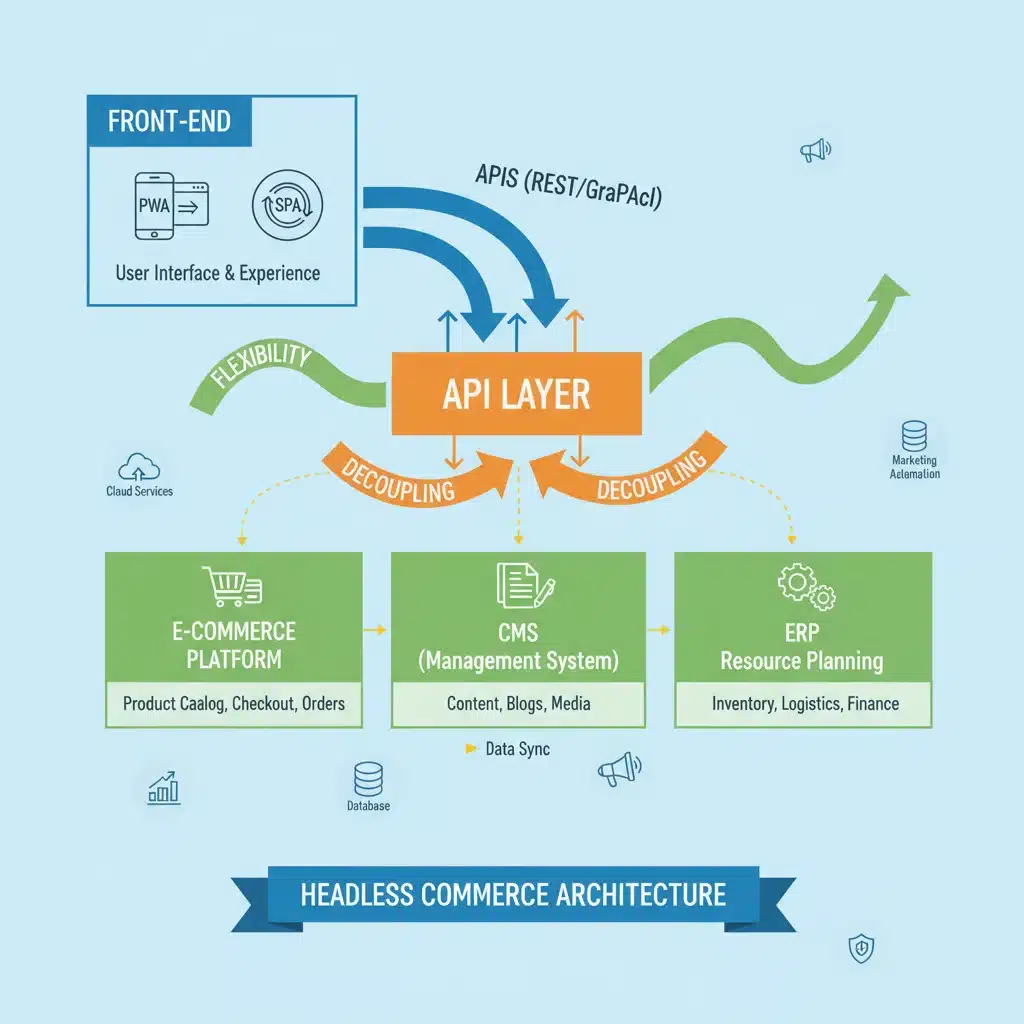
- Headless E-commerce Platform (Commerce Engine): Options include Shopify Plus, BigCommerce, Commercetools, Adobe Commerce (Magento Open Source/Commerce), or custom solutions. Evaluate based on API capabilities, scalability, cost, and fit with your existing back-end.
- Content Management System (CMS): A headless CMS (e.g., Contentful, Strapi, Sanity.io) is essential for managing content independently of the presentation layer.
- Front-end Framework: React, Vue.js, Angular are popular choices for building Progressive Web Apps (PWAs) or Single Page Applications (SPAs).
- Integration Layer: Consider API gateways or integration platforms (iPaaS) to manage the flow of data between systems.
Conduct thorough due diligence, request demos, and assess vendor support and community resources. Pay close attention to the API documentation and developer experience.
Month 2-3: Architectural Design and Back-End Integration
Detailed Architectural Design (Month 2, Week 1-2)
With vendors selected, the next phase of the headless commerce roadmap focuses on detailed design:
- API Strategy: Define how different systems will communicate. This includes designing RESTful or GraphQL APIs for product data, customer information, orders, inventory, and content.
- Data Model: Standardize data models across your commerce engine, PIM, and CMS to ensure consistency.
- System Integrations: Map out all necessary integrations with your existing ERP, CRM, OMS, payment gateways, shipping providers, and other third-party services. Prioritize critical integrations.
- Security Architecture: Design robust security protocols for API authentication, data encryption, and compliance (e.g., PCI DSS).
- Scalability and Performance Planning: Outline caching strategies, CDN implementation, and server infrastructure to support high performance and traffic.
Back-End Development and API Implementation (Month 2, Week 3 – Month 3, Week 4)
This is where the core back-end work of your headless commerce roadmap begins:
- Commerce Engine Configuration: Set up your chosen headless e-commerce platform, configuring products, categories, pricing rules, promotions, and customer accounts.
- CMS Setup: Configure your headless CMS, defining content models for pages, blog posts, product descriptions, banners, and other marketing assets.
- API Development & Integration: Develop custom APIs where necessary and integrate your commerce engine, CMS, and other back-end systems. This involves extensive testing of API endpoints to ensure data accuracy and reliability.
- Data Migration Strategy: Plan how existing product data, customer data, and order history will be migrated to the new systems.
Regular communication between front-end and back-end teams is crucial during this phase to ensure API contracts are met and development progresses smoothly.
Month 4-5: Front-End Development and UX/UI Build-Out
Front-End Development Sprints (Month 4, Week 1 – Month 5, Week 3)
This phase is dedicated to building the customer-facing experience, a critical component of your headless commerce roadmap. Using your chosen front-end framework:
- Component Library Development: Build reusable UI components (buttons, forms, product cards, navigation elements) to ensure consistency and accelerate development.
- Page Development: Construct key e-commerce pages: homepage, category pages, product detail pages, cart, checkout, customer accounts, and content pages.
- API Consumption: Integrate the front-end with the back-end APIs to fetch and display data dynamically.
- Performance Optimization: Implement client-side caching, image optimization, code splitting, and other techniques from the outset to achieve the target 25% faster site speed. Use tools like Lighthouse and WebPageTest for continuous monitoring.
- Responsive Design: Ensure the front-end is fully responsive and optimized for various devices (desktop, tablet, mobile).
- Accessibility (A11y): Build with accessibility in mind, adhering to WCAG guidelines.
UX/UI Refinement and Testing (Month 5, Week 3-4)
As the front-end takes shape, continuous testing and refinement are vital:
- User Acceptance Testing (UAT): Engage business stakeholders and a small group of end-users to test the new front-end, gather feedback, and identify usability issues.
- Cross-Browser and Device Testing: Ensure consistent performance and appearance across different browsers and devices.
- Performance Testing: Conduct rigorous performance tests to validate the 25% faster site speed goal. Measure Core Web Vitals and identify any bottlenecks.
- Security Testing: Perform penetration testing and vulnerability assessments on the front-end and API layer.
- SEO Audit: Verify that SEO best practices (meta tags, structured data, canonical URLs) are implemented correctly on the new front-end.
Month 6: Pre-Launch, Deployment, and Post-Launch Optimization
Final Testing and Pre-Launch Preparations (Month 6, Week 1-2)
The final push in your headless commerce roadmap before going live:
- End-to-End Testing: Conduct comprehensive testing of the entire customer journey, from browsing to checkout and order confirmation, across all integrated systems.
- Load Testing: Simulate high traffic volumes to ensure the platform can handle peak loads without performance degradation.
- Data Migration Finalization: Execute the final data migration, ensuring all product, customer, and order data is accurately transferred.
- Content Population: Ensure all necessary content (product descriptions, images, marketing copy, blog posts) is populated in the headless CMS and correctly rendered on the front-end.
- Training: Train internal teams (marketing, customer service, merchandising) on how to use the new CMS and manage the headless platform.
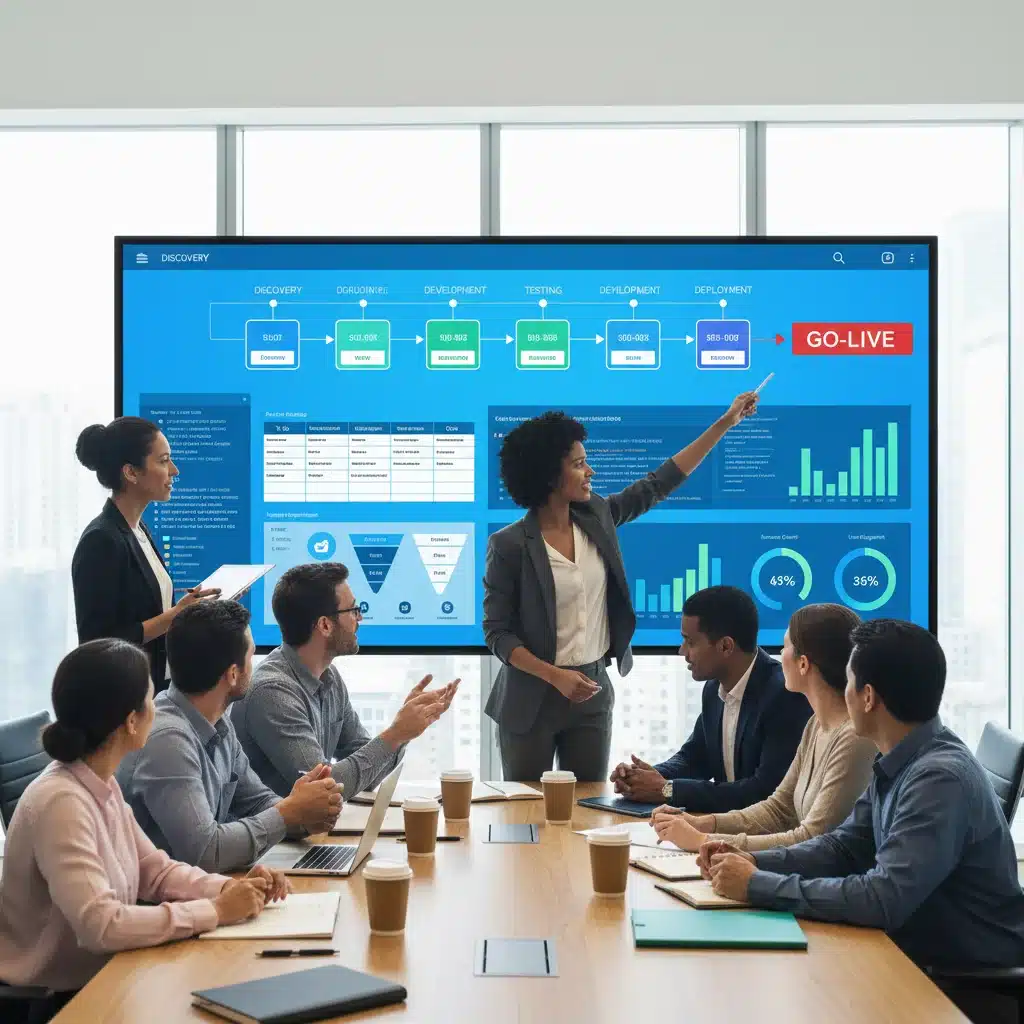
- Go-Live Checklist: Develop a detailed checklist for deployment, including DNS updates, CDN configuration, monitoring setup, and rollback plans.
Deployment and Go-Live (Month 6, Week 3)
Execute the deployment plan, ideally during a low-traffic period. Closely monitor the site immediately after launch:
- Real-time Monitoring: Use analytics tools and performance monitoring dashboards to track site speed, errors, user behavior, and conversion rates.
- Immediate Issue Resolution: Have your technical team on standby to address any critical issues that arise post-launch.
Post-Launch Optimization and Iteration (Month 6, Week 4 and Beyond)
A headless commerce roadmap doesn’t end at launch. Continuous improvement is key:
- Performance Monitoring & Tuning: Continuously monitor site speed metrics (Core Web Vitals) and identify areas for further optimization to maintain and exceed the 25% faster site speed goal.
- A/B Testing: Experiment with different UI elements, content, and features to optimize conversion rates and user experience.
- User Feedback Loop: Establish channels for collecting user feedback and incorporate it into future iterations.
- Feature Development: Plan for ongoing feature development based on business needs and market trends, leveraging the agility of your headless architecture.
- SEO Monitoring: Continuously monitor SEO performance, ensuring search engine visibility remains strong or improves.
Key Considerations for US Retailers on the Headless Commerce Roadmap
While the benefits are clear, US retailers embarking on a headless commerce roadmap should keep several critical factors in mind:
- Budget and Resources: Headless implementations can be more complex and require specialized development skills. Factor in costs for platforms, development, integrations, and ongoing maintenance.
- Internal Expertise: Assess your in-house team’s capabilities. You may need to invest in training or hire external agencies with headless expertise.
- Change Management: Prepare your organization for a significant shift in how digital experiences are created and managed.
- SEO Strategy: While headless offers great SEO potential, it requires careful planning to ensure proper indexing and crawlability, especially for PWAs/SPAs. Server-side rendering (SSR) or static site generation (SSG) are often crucial.
- Third-Party Integrations: Map out all essential integrations early. Each integration adds complexity and potential points of failure.
- Scalability of APIs: Ensure your chosen platforms and custom APIs can handle anticipated traffic and data volumes.
Measuring Success: Achieving 25% Faster Site Speed by 2026
The core objective of this headless commerce roadmap is a tangible improvement in site speed. To measure and validate the 25% faster site speed by 2026, focus on:
- Baseline Metrics: Establish clear baseline metrics for your current site’s performance before beginning the project. Use tools like Google PageSpeed Insights, Lighthouse, GTmetrix, and WebPageTest.
- Key Performance Indicators (KPIs): Track Core Web Vitals (LCP, FID, CLS) rigorously. Also, monitor Time to Interactive (TTI) and First Contentful Paint (FCP).
- Continuous Monitoring: Implement real-user monitoring (RUM) tools to track actual user experiences and identify performance bottlenecks in real-time.
- A/B Testing: If performing a phased rollout, A/B test the headless version against the monolithic version to quantify performance gains and business impact.
- Business Impact: Correlate site speed improvements with business metrics like conversion rates, bounce rates, average session duration, and overall revenue. A faster site directly contributes to a better customer experience, which in turn drives higher engagement and sales.
Conclusion
The journey to headless commerce is a strategic investment that promises significant returns for US retailers willing to embrace innovation. This 6-month headless commerce roadmap provides a structured, actionable plan to navigate this transformation successfully. By carefully planning, building a strong team, selecting the right technologies, and prioritizing performance from day one, retailers can achieve the ambitious goal of a 25% faster site speed by 2026, leading to improved customer satisfaction, higher conversion rates, and a resilient, future-proof digital platform. The future of retail is fast, flexible, and customer-centric, and headless commerce is the architecture to get you there.
Are you ready to accelerate your digital journey and redefine your online retail experience? The time to embark on your headless commerce roadmap is now.